Serviced Apartments: The Best Rental Investment in Malaysia?
Introduction
When exploring real estate investment opportunities in Malaysia, one property category consistently dominates conversations: serviced apartments. Promising rental yields of 6-9% compared to 4-5% for standard condominiums, these serviced residences attract increasing numbers of foreign and local investors. Located in prime areas like KLCC, Mont Kiara, or Bangsar, fully furnished and benefiting from constant demand from expatriates and business travelers, serviced apartments seem to tick all the boxes for the ideal investment.
But does this superior profitability hide pitfalls? Commercial-rate charges multiplied by six for electricity, operating costs RM 2,000 higher per year, absence of HDA protection on certain projects, and limited long-term capital appreciation can quickly transform a promising investment into a financial sinkhole. The difference between a successful investment and a money pit lies in understanding these mechanisms thoroughly.
In this comprehensive guide, we objectively analyze serviced apartments as an investment vehicle. You’ll discover real advantages, hidden costs, detailed profitability calculations, case studies with actual numbers, and most importantly, a clear answer: are serviced apartments really the best rental investment in Malaysia? For which investor profile are they suitable, and under what conditions can they outperform a standard condominium?
1. What is a Serviced Apartment in Malaysia?
The official definition
A serviced apartment in Malaysia is a high-rise residential property built on commercial-titled land, not residential land. This land title distinction is absolutely crucial and determines all financial and legal obligations that apply to the owner.
Unlike condominiums which have a residential title and are governed by strict buyer protection laws, serviced apartments operate in a legal grey area that presents both opportunities and risks.
The two types of serviced apartments
There are actually two distinct categories of serviced apartments in Malaysia, often confused by foreign investors:
Type 1: “True” serviced apartments
These are upscale residences that genuinely offer complete hotel-like services:
- Daily or weekly housekeeping
- 24/7 room service and concierge
- Laundry and dry cleaning
- Shuttle services
- Professional hotel management by a recognized chain (Ascott, Fraser, Marriott Executive Apartments)
Examples: The Ascott KLCC, Lanson Place Bukit Ceylon, Fraser Place, Marriott Executive Apartments Kuala Lumpur.
These establishments target premium clientele: business travelers on assignments of several weeks, expatriates in transition, affluent tourists seeking apartment comfort with 5-star hotel services. Rental rates are naturally high (RM 5,000 to RM 15,000/month depending on size and services).
Type 2: “Serviced apartments” in name only
This is the most common category and the one concerning most investors. These are stratified residential units built on commercial land, marketed under the name “serviced apartment,” “serviced residence,” or “serviced suite,” but which do not offer daily hotel services.
These residences offer the same amenities as a standard condominium:
- 24/7 security
- Swimming pool and gym
- Parking
- Elegant entrance lobbies
The main difference? They’re located above or in immediate proximity to shopping malls (mixed-development), in ultra-central areas, and are generally delivered fully furnished. But the term “serviced” is actually a marketing argument more than an operational reality.
Examples: Sky Suites @ KLCC, Vortex Service Residence, M Vertica Cheras, Mercu Summer Suites, Park Sky Residence Bukit Jalil.
The crucial difference with a condominium
The fundamental distinction lies in the land status:
| Criteria | Condominium | Serviced Apartment |
|---|---|---|
| Land title | Residential Title | Commercial Title |
| HDA protection | Yes, covered by Housing Development Act | No, or partially depending on State |
| Electricity rate | Domestic (RM 3 minimum) | Commercial (RM 7.20 minimum – LV) |
| Water rate | Domestic (RM 6 minimum KL/Putrajaya) | Commercial (RM 36 minimum – ×6) |
| Assessment tax | 3.5% (stratified residential) | 5-8.8% (commercial/SOHO) |
| Quit rent | Low | Higher |
| Maintenance fees | Residential | Commercial (generally higher) |
| Security | Controlled (residents only) | More open access (attached mall) |
This land status difference results in structurally higher operating costs for serviced apartments. According to PropertyGuru Malaysia data, a serviced apartment owner can expect to pay between RM 1,300 and RM 1,500 more per year than a comparable condominium owner, solely in fixed charges (electricity, water, taxes).
Recent legislative evolution
Since the 2021 reform, certain serviced apartments and SoHo (Small Office Home Office) now fall under Housing Development Act protection, provided the Development Order was issued for mixed-use “commercial AND residential” by the local authority.
This has allowed in some cases to obtain a reclassification of electricity and water rates from commercial to residential, through an appeal process with TNB (Tenaga Nasional Berhad) and water authorities. However, this process is neither automatic nor guaranteed, and depends on many administrative factors and the developer’s goodwill.
Key point to remember: Before investing in a serviced apartment, systematically verify whether the project is covered by the HDA and whether utility rates have been negotiated at residential rates by the developer. This information can make a difference of several hundred ringgit per month on your net cash flow.
2. Concrete Advantages for the Investor
Despite higher operating costs, serviced apartments present undeniable assets that explain their growing popularity among savvy investors. Let’s analyze the real, quantified, and verifiable advantages.
Rental yields superior to average
This is the flagship argument attracting investors: serviced apartments generate significantly higher gross rental yields than standard condominiums.
Market data (2024-2025):
- Average Kuala Lumpur condominium yield: 4-5% gross
- Average serviced apartment yield in premium areas: 6-9% gross
- Documented cases of yields reaching 9% net (example: Faizul Ridzuan, KLCC investment)
Let’s take a concrete example based on EdgeProp data:
Mercu Summer Suites (KLCC):
- Median purchase price: RM 398,000
- Median monthly rent: RM 2,400
- Annual rental income: RM 28,800
- Gross yield: 7.2%
Compare with an equivalent condominium in the same area:
Standard KLCC condominium:
- Median purchase price: RM 450,000
- Median monthly rent: RM 2,200
- Annual rental income: RM 26,400
- Gross yield: 5.9%
The 1.3 percentage point difference represents a substantial gap over the long term. On a RM 400,000 investment, this equals RM 5,200 in additional income per year.
Diversified and constant rental demand
One of the major assets of serviced apartments lies in the diversity of their tenant clientele, which reduces the risk of prolonged vacancy.
Target tenant segments:
1. Expatriates in early installation phase (20-30% of market) Expatriates arriving in Malaysia for a 2-3 year assignment often seek furnished accommodation, central, with easy access to amenities. A serviced apartment in Mont Kiara or Bangsar with direct mall access perfectly meets this demand. Typical lease duration: 12 to 24 months.
2. Long-term business travelers (15-25%) Consultants, project managers, or professionals on several-month assignments prefer the flexibility and comfort of a serviced apartment over hotel rooms. Higher rental rates (RM 3,500-6,000/month), but more frequent turnover.
3. Digital nomads and remote workers (10-20%, growing) With the rise of remote work, Malaysia attracts increasing numbers of European, American, and Asian digital nomads. Well-located serviced apartments with high-speed WiFi and nearby coworking spaces are highly sought after. Duration: 3 to 12 months.
4. Upscale tourists (10-15%) For stays from 1 week to 3 months, families or groups of friends often prefer a serviced apartment to multiple hotels. High profitability via Airbnb or similar platforms (attention to local regulations).
5. Affluent international students (5-10%) Near international universities (Sunway, Taylor’s, Monash), serviced apartments attract students whose families seek comfort and security. Long leases (10-12 renewable months).
6. Local couples without children (15-20%) Young Malaysian professionals who value proximity to CBD and urban lifestyle without house maintenance.
This diversity allows quick pivoting in case of market change. If expatriates become scarce (economic crisis), you can target digital nomads. If tourism slows, switch to long-term rental.
Strategic location: the premium factor
Serviced apartments generally benefit from prime locations:
Immediate proximity to CBDs (Central Business Districts):
- KLCC: Petronas Twin Towers, Suria KLCC, multinational offices
- KL Sentral: Transport hub, KLIA Express connection
- Bangsar: Cosmopolitan district, restaurants, nightlife
- Mont Kiara: Expatriate enclave, international schools
Accessibility to public transport: According to the Malaysian Property Market Report 2017, properties located near LRT lines (Kelana Jaya extension) and MRT (Sungai Buloh-Kajang) saw their prices increase significantly. Serviced apartments capitalize on this location premium.
Example: 8 Conlay has direct access to Conlay MRT station within walking distance, significantly increasing its rental attractiveness.
Integration in mixed-developments: Most serviced apartments are built above or next to shopping malls:
- Sky Park Residences (Bukit Jalil): direct access to Pavilion 2
- Vortex Service Residence: proximity to Pavilion KL
- M Vertica: integrated in Cheras South development
This immediate proximity to shops, restaurants, supermarkets, and entertainment is a strong argument for tenants, justifying premium rents.
Turnkey furnished: reduced initial investment
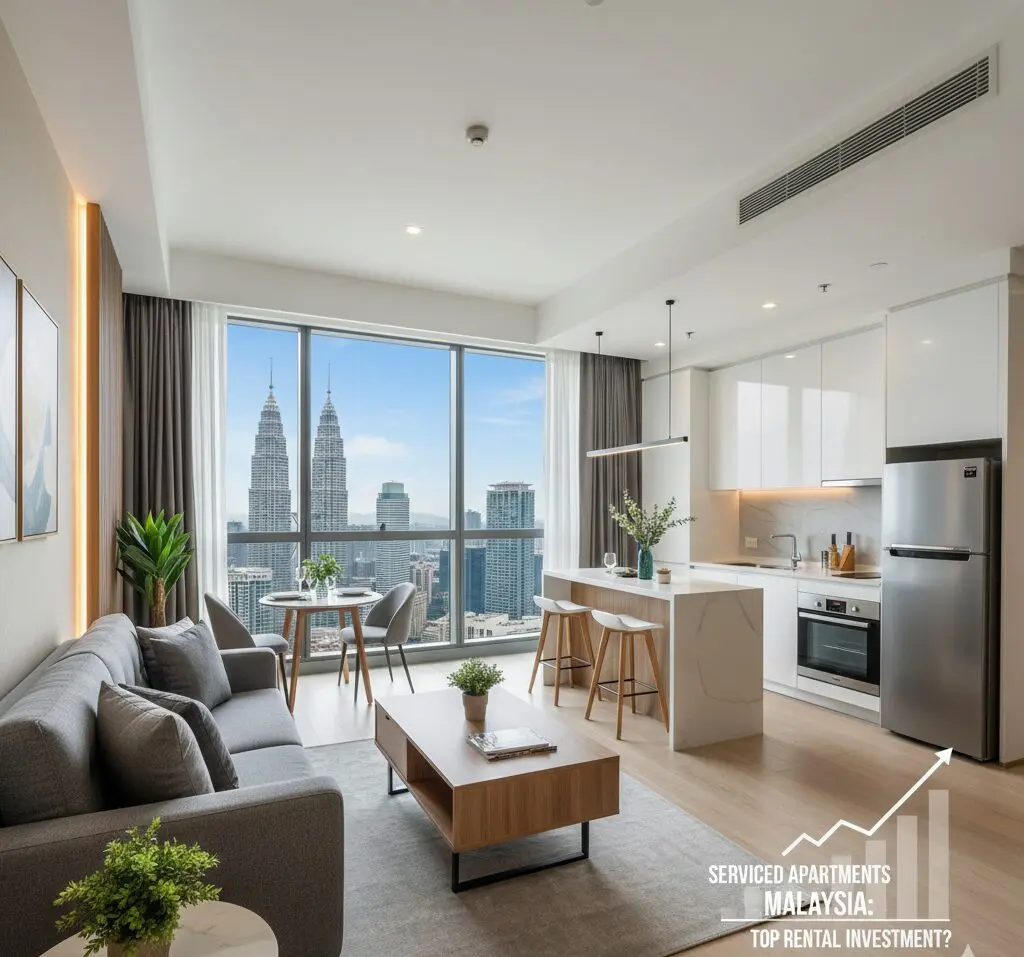
Unlike condominiums generally delivered “bare” (unfurnished), serviced apartments are fully furnished from delivery:
Standard equipment included:
- Furniture: bed, wardrobes, sofa, dining table
- Appliances: air conditioning, refrigerator, washing machine, microwave
- Equipped kitchen: cooktop, hood
- Basic decoration: curtains, lighting
Financial advantage: The investor saves between RM 30,000 and RM 60,000 in initial furnishing costs, capital that can be allocated elsewhere or kept as cash reserve.
Marketing advantage: A furnished property typically rents for 15-25% more than a comparable unfurnished property. In a competitive market, this is a decisive advantage for quickly finding a tenant.
Rental flexibility: short term AND long term
One of the major strategic assets of serviced apartments is their rental versatility:
Option 1: Long-term rental (12-24 months)
- Stable and predictable income
- Less turnover and management fees
- Fewer regulatory risks
- Monthly rent: RM 2,000-4,000 depending on location
Option 2: Medium-term rental (3-6 months)
- Slightly higher rates (15-20% premium)
- Flexibility for business travelers
- Interesting compromise between stability and profitability
- Monthly rent: RM 2,500-5,000
Option 3: Short-term rental / Airbnb (nights/weeks)
- Maximum revenue potential (up to 50% higher)
- Strong demand in tourist areas (KLCC, Bukit Bintang)
- More intensive management and high turnover costs
- Warning: Check local regulations and condominium rules
This flexibility allows optimizing yield according to economic cycles. During high tourist demand periods (festivals, events), switch to short term. During slowdown periods, secure long leases.
Services and amenities: enhanced attractiveness
Serviced apartments generally offer superior facilities to standard condominiums:
Common premium installations:
- Olympic-sized swimming pools (50m)
- Equipped gyms (cardio, weights, sometimes group classes)
- Coworking spaces and business lounges
- Meeting rooms
- Relaxation areas (landscaped gardens, BBQ areas)
- 24/7 concierge and reception
These services justify higher rents from demanding clientele accustomed to international standards.
Example: ARC @ Austin Hills (Johor Bahru) offers privileged access to Austin Heights Golf & Hotel Resort, a decisive argument for sports-minded tenants and affluent families.
Growing market: favorable context
The serviced apartment market is experiencing structural growth in Southeast Asia:
Macro data:
- Projected SA market growth in Southeast Asia: 12.6% CAGR (2025-2032)
- Asia-Pacific represents 11.5% of the global serviced apartment market (2025)
- Malaysia benefits from tourism growth (+25 million visitors in 2013, upward trend)
Supporting factors:
- Rapid urbanization of Kuala Lumpur and Penang
- Increasing disposable income of Malaysian middle class
- Rise of remote work and digital nomads post-COVID
- Government policies favoring tourism and foreign investment
Recent example: The 2025 launch of Marriott Executive Apartments KL (353 units) confirms international operators’ confidence in this segment.
3. Disadvantages and Hidden Costs
While serviced apartments offer attractive yields, they also carry structural disadvantages and hidden costs that every investor must absolutely master before committing. Let’s review them exhaustively and factually.
High operating charges: the impact of commercial status
The Achilles’ heel of serviced apartments lies in their increased operating costs, directly linked to their commercial land status.
Commercial electricity rates
In Malaysia, electricity rates are structured differently according to type of use:
| Type | Minimum monthly rate | Cost for 251 kWh (national average) |
|---|---|---|
| Residential | RM 3.00 | RM 60.63 |
| Commercial (LV) | RM 7.20 | RM 112.96 |
Annual electricity surcharge: RM 627.96 (+86% compared to residential)
For a family consuming 400 kWh/month (more realistic with air conditioning), the difference reaches RM 1,200/year.
Commercial water rates
The differential is even more brutal:
| Type | Minimum monthly rate (KL/Putrajaya) |
|---|---|
| Domestic | RM 6.00 |
| Commercial | RM 36.00 (×6) |
Annual water surcharge: RM 360 minimum
For average consumption of 35m³/month, the gap can exceed RM 600/year.
Increased assessment tax and quit rent
Local authorities impose higher property tax rates for commercial properties:
Concrete examples:
Shah Alam City Council:
- Condominium (stratified residential): 3.5% of annual value
- Serviced apartment: 5.0% of annual value
- SoHo: 5.0% also
Majlis Bandaran Petaling Jaya (MBPJ):
- Condominium: 6.0%
- Serviced apartment: 6.6%
- SoHo: 8.8%
Financial impact: On an annual value of RM 10,000, the difference between a condo (RM 600) and an SA (RM 660-880) represents RM 60 to 280/year additional.
Quit rent (cukai tanah) is also higher for commercial land, with variations by State.
Higher maintenance fees
Monthly management fees (maintenance fees) for serviced apartments are structurally higher:
Reasons:
- Commercial rates applied to common areas (electricity, water)
- Additional services (24/7 concierge, enhanced security)
- Premium equipment (Olympic pools, equipped gyms)
- More sophisticated management
Observed range:
- Standard condominium: RM 0.30-0.45/sqft
- Serviced apartment: RM 0.45-0.65/sqft
For a 500 sqft studio, this represents RM 75-150 more per month, or RM 900-1,800/year.
The true annual cost: summary table
Let’s synthesize these surcharges in a realistic comparative table:
| Expense item | Condominium | Serviced Apartment | SA Surcharge |
|---|---|---|---|
| Electricity (250 kWh/month) | RM 728/year | RM 1,355/year | +RM 627 |
| Water | RM 72/year | RM 432/year | +RM 360 |
| Assessment tax | RM 600/year | RM 660-880/year | +RM 60-280 |
| Maintenance fees (500 sqft) | RM 2,160/year | RM 3,060/year | +RM 900 |
| TOTAL SURCHARGE | – | – | +RM 1,947-2,167/year |
Quantified conclusion: A serviced apartment owner should expect to pay between RM 1,950 and RM 2,200 more per year than an equivalent condominium owner.
This surcharge must imperatively be integrated into the net profitability calculation. A 7% gross yield can quickly drop to 4-5% net once these charges are deducted.
Absence of HDA protection: increased legal risk
The Housing Development Act (HDA) of 1966 offers essential protection to buyers of residential properties in Malaysia:
HDA protections:
- Obligation for developer to open a separate project account
- Protection against misuse of funds
- Guaranteed Defects Liability Period (DLP)
- Recourse procedures in case of non-delivery or delays
Problem: Historically, serviced apartments built on commercial land were not covered by the HDA.
Consequences:
- Risk of ill-intentioned developer using funds for other purposes
- Abandoned projects without legal recourse
- Construction defects difficult to enforce
- Delivery delays without compensation
Recent evolution: Since 2021, certain States have extended HDA protection to serviced apartments and SoHo, provided that:
- The Development Order mentions “mixed” use (commercial + residential)
- Approved plans clearly indicate “dwelling purposes”
Critical recommendation: Before buying, explicitly verify with the developer and your solicitor whether the project is covered by the HDA. Demand written confirmation. This protection can make the difference between a secure investment and a legal nightmare.
Limited long-term capital appreciation
Several experts, including Siders Sittampalam (consultant at PPC International), warn about the risk of value stagnation for serviced apartments over the long term.
Arguments:
KLCC market oversupply: According to a PPC International study, there were already 3,867 serviced apartment units under development in the KLCC area (including ongoing and planned projects). This massive supply raises the question of rental market absorption.
Yield compression: In oversupply situations, rental competition intensifies, lowering rents, therefore yields, therefore attractiveness for new investors.
Lesser capital appreciation: Historical data show that serviced apartments tend to appreciate less in value than well-located freehold condominiums. The reason: commercial status, perceived as less desirable for a primary residence, limits demand from owner-occupiers.
Concrete example: Sky Suites @ KLCC saw its median transaction price stagnate between 2021 and 2023 (+1% only), then drop 6.6% in 2024 to RM 934,000. Conversely, Banyan Tree Signatures (luxury serviced residence) recorded a 30.7% increase in 2024 thanks to its ultra-premium positioning.
Conclusion: Capital gain is not guaranteed and depends heavily on project positioning and overall market evolution.
Reduced security: more open access
Unlike purely residential condominiums, serviced apartments integrated into mixed-developments (shopping malls) present a lower security level:
Observed issues:
- Access to mall common areas allowing non-residents to easily enter residential towers
- Less strict access control systems than in gated condos
- Significant daily traffic (shoppers, mall visitors) creating a less intimate environment
Impact for tenants: Families with children and people seeking tranquility and privacy often prefer strictly residential condominiums. This can limit your pool of potential tenants.
Bank financing: sometimes stricter conditions
Some Malaysian banks apply slightly differentiated loan conditions for serviced apartments:
Potential differences:
- Loan-to-Value (LTV) ratio sometimes capped at 80% (vs 90% for certain condos)
- Marginally higher interest rates (0.1-0.3%)
- Higher income requirements
For foreigners: Financing remains accessible but generally requires:
- Down payment of 30-40% minimum
- Solid international income documentation
- Interest rate +0.5-1% compared to locals
Recommendation: Consult several banks (Maybank, CIMB, Hong Leong Bank, RHB) to compare specific offers for serviced apartments.
Management complexity: turnover and associated costs
If you opt for a short-term rental strategy (Airbnb, Booking.com), prepare for high management costs:
Turnover costs:
- Professional cleaning between each tenant: RM 100-200/cleaning
- Laundry (sheets, towels): RM 50-80/turnover
- Accelerated wear of furniture and equipment
- Management time (bookings, check-in/out, communication)
Solution: Engage a specialized property management company, but this represents 20-30% of your rental income.
For long-term rental, management is simpler but still necessary, especially if you’re abroad.
4. Comparative Analysis: Serviced Apartment vs Condominium
To determine whether serviced apartments are truly more profitable, let’s conduct a comprehensive quantified comparison on a concrete investment case.
Starting assumptions
Property A: Serviced Apartment (Mont Kiara)
- Purchase price: RM 450,000
- Size: 650 sqft (2 bedrooms)
- Status: Leasehold, commercial title
- Fully furnished
- Monthly rent: RM 2,600
- Occupancy rate: 90% (long-term rental)
Property B: Condominium (Mont Kiara)
- Purchase price: RM 450,000
- Size: 680 sqft (2 bedrooms)
- Status: Freehold, residential title
- Unfurnished (furniture investment: RM 35,000)
- Monthly rent: RM 2,200 (furnished after investment)
- Occupancy rate: 92%
Common financing:
- Loan-to-Value: 70%
- Amount borrowed: RM 315,000
- Interest rate: 4.5%/year
- Duration: 30 years
- Monthly payment: RM 1,596
Gross yield calculation
Serviced Apartment:
- Gross annual rental income: RM 2,600 × 12 × 90% = RM 28,080
- Total acquisition cost: RM 450,000
- Gross yield: 6.24%
Condominium:
- Gross annual rental income: RM 2,200 × 12 × 92% = RM 24,288
- Total acquisition cost: RM 450,000 + RM 35,000 (furniture) = RM 485,000
- Gross yield: 5.01%
Serviced Apartment advantage: +1.23 points gross yield
Annual charges calculation
Serviced Apartment:
- Electricity: RM 1,200
- Water: RM 400
- Assessment tax: RM 750
- Quit rent: RM 150
- Maintenance fees (RM 0.50/sqft): RM 3,900
- Insurance: RM 500
- Repairs/maintenance: RM 800
- Total charges: RM 7,700/year
Condominium:
- Electricity: RM 700
- Water: RM 150
- Assessment tax: RM 450
- Quit rent: RM 80
- Maintenance fees (RM 0.35/sqft): RM 2,856
- Insurance: RM 500
- Repairs/maintenance: RM 800
- Total charges: RM 5,536/year
Charge difference: RM 2,164/year in favor of condominium
Net cash flow calculation (before taxes)
Serviced Apartment:
- Annual rental income: RM 28,080
- Operating charges: -RM 7,700
- Bank payments: -RM 19,152 (RM 1,596 × 12)
- Annual net cash flow: RM 1,228
- Monthly cash flow: RM 102
Condominium:
- Annual rental income: RM 24,288
- Operating charges: -RM 5,536
- Bank payments: -RM 19,152
- Annual net cash flow: -RM 400
- Monthly cash flow: -RM 33
Result: The serviced apartment generates a positive cash flow of RM 102/month, while the condominium is in negative cash flow of RM 33/month.
Cash-on-cash return calculation
Cash-on-cash return measures the return on capital actually invested (personal contribution).
Serviced Apartment:
- Personal contribution: RM 135,000 (30%) + acquisition fees RM 15,000 = RM 150,000
- Annual net cash flow: RM 1,228
- Cash-on-cash ROI: 0.82%
Condominium:
- Personal contribution: RM 135,000 + RM 35,000 (furniture) + RM 15,000 (fees) = RM 185,000
- Annual net cash flow: -RM 400
- Cash-on-cash ROI: -0.22%
Interim conclusion: In the short term (1-3 years), the serviced apartment offers immediate positive cash flow, which is crucial for investors seeking regular income. The condominium requires monthly “subsidy” from the owner.
10-year projection: capital appreciation
Appreciation assumptions:
- Serviced apartment: 2%/year (modest appreciation)
- Condominium (freehold): 3.5%/year (standard premium area appreciation)
Estimated value after 10 years:
Serviced Apartment:
- Initial value: RM 450,000
- Value after 10 years: RM 450,000 × (1.02)^10 = RM 548,335
- Gross capital gain: RM 98,335
- RPGT (5% after 6 years for non-residents): -RM 4,917
- Net capital gain: RM 93,418
Condominium:
- Initial value: RM 450,000
- Value after 10 years: RM 450,000 × (1.035)^10 = RM 636,857
- Gross capital gain: RM 186,857
- RPGT (5%): -RM 9,343
- Net capital gain: RM 177,514
Condominium advantage: +RM 84,096 capital gain
Total 10-year return (IRR)
Serviced Apartment:
- Cumulative cash flows over 10 years: RM 1,228 × 10 = RM 12,280
- Net resale capital gain: RM 93,418
- Loan capital repayment (years 1-10): ~RM 45,000
- Remaining loan balance: RM 270,000
- Total net gain: RM 12,280 + RM 93,418 – (RM 315,000 – RM 270,000) = RM 60,698
- Total ROI on initial contribution (RM 150,000): 40.5% over 10 years = 3.5%/year
Condominium:
- Cumulative cash flows over 10 years: -RM 400 × 10 = -RM 4,000
- Net resale capital gain: RM 177,514
- Loan capital repayment: ~RM 45,000
- Total net gain: -RM 4,000 + RM 177,514 – RM 45,000 = RM 128,514
- Total ROI on initial contribution (RM 185,000): 69.5% over 10 years = 5.4%/year
Comparative analysis verdict
Over 10 years, the freehold condominium wins with a total ROI 1.9 points higher per year, thanks to:
- Better capital appreciation (+84k RM)
- Operating charges RM 21,640 lower cumulative
BUT: The serviced apartment offers:
- Immediate positive cash flow (important for self-financing)
- Lower initial investment (no furniture)
- Potentially superior liquidity (broad rental market)
The answer therefore depends on your strategy:
- Short-term yield / cash flow investor → Serviced Apartment
- Long-term wealth / capital gain investor → Freehold condominium
5. Real Returns: What Can You Actually Expect?
Beyond theoretical comparisons, let’s examine real yields observed in the Malaysian market, with concrete and verifiable data.
Average yields by geographic zone
According to GlobalPropertyGuide data (Q3 2025) and EdgeProp Malaysia, here are average gross rental yields:
Kuala Lumpur – Center (KLCC, Bukit Bintang):
- Serviced apartments: 5.5-7.5% gross
- Condominiums: 4.5-5.5% gross
- Average gap: +1.5 points
Kuala Lumpur – Peripheral areas (Mont Kiara, Bangsar, Desa ParkCity):
- Serviced apartments: 5.0-6.5% gross
- Condominiums: 4.0-5.0% gross
- Average gap: +1.3 points
Penang (Georgetown, Bayan Lepas):
- Serviced apartments: 5.5-7.0% gross
- Condominiums: 4.5-5.5% gross
- Average gap: +1.2 points
Johor Bahru (Singapore proximity, Iskandar):
- Serviced apartments: 6.0-8.0% gross
- Condominiums: 5.0-6.0% gross
- Average gap: +1.5 points
Emerging areas (Kepong, Sungai Besi, Subang Jaya):
- Serviced apartments: 6.5-8.5% gross
- Condominiums: 5.5-7.0% gross
- Average gap: +1.3 points
From gross to net: the importance of charges
Gross yield is misleading. Let’s calculate real net yield by integrating all charges:
Example: KLCC Serviced Apartment
- Gross yield: 7.0%
- Operating charges: -1.7% (electricity, water, taxes, maintenance)
- Rental vacancy (10%): -0.7%
- Management (if agency): -0.5%
- Net yield: 4.1%
Example: KLCC Condominium
- Gross yield: 5.5%
- Operating charges: -1.2%
- Rental vacancy (8%): -0.4%
- Management: -0.5%
- Net yield: 3.4%
Conclusion: The net yield gap between SA and condo reduces to approximately 0.7 point once all costs are integrated.
Leverage effect: maximizing cash-on-cash return
Intelligent use of bank leverage can considerably improve ROI on your personal contribution.
Scenario without leverage (100% cash):
- Investment: RM 450,000
- Annual net income: RM 3,500 (after charges)
- ROI: 0.78% (mediocre)
Scenario with leverage (70% loan, 4.5% interest):
- Personal contribution: RM 135,000
- Net income: RM 3,500
- Credit cost: -RM 2,300 (net interest after capital repayment deduction)
- Net cash flow: RM 1,200
- Cash-on-cash ROI: 0.89% (slightly better, but attention to risk)
Important: Leverage amplifies gains… and losses. In case of value drop or prolonged vacancy, loan repayment can become an unbearable burden.
Exceptional cases: the “outliers”
Some investors have obtained exceptional returns, well above average. Let’s analyze these success stories to draw lessons.
Faizul Ridzuan case (documented in TheRakyatPost, 2025):
- Purchase: Leasehold KLCC serviced apartment near cemetery
- Price: RM 750/sqft (20% below market)
- Rent obtained: generates 9% net yield
- Investment duration: 10 years
- Monthly cash flow after all charges: RM 500+
- Capital gain: current value RM 1,000-1,100/sqft (+33-47%)
Success factors:
- Counter-cyclical purchase: perfect timing (purchase at depressed price)
- Stigma acceptance: cemetery proximity = unjustified discount
- Rental diversification: 3+ different rental strategies (resilience)
- Long-term vision: held through initial negative cash flow period
- Premium area choice: KLCC, commercial development around
Lesson: Exceptional returns often require going against consensus and accepting perceived “defects” that aren’t real defects.
Realistic yields by investor profile
Passive investor (agency management, long-term rental):
- Expected net yield: 3.0-4.5% after all charges
- Minimal work, stable income
Active investor (self-management, rent optimization):
- Expected net yield: 4.5-6.5% after charges
- Requires involvement, monitoring, responsiveness
Expert investor (short/long-term mix, timing, renovations):
- Expected net yield: 6.5-9.0% possible
- Advanced skills required, significant time invested
6. Case Study: Real KLCC Investment
To concretely illustrate the principles discussed, let’s analyze a detailed investment case in a KLCC serviced apartment.
Project presentation: Sky Suites @ KLCC
Characteristics:
- Developer: Monoland Corporation
- Completion year: 2019
- Status: Freehold, serviced apartment
- Number of units: 986
- Unit sizes: 649 to 887 sqft
- 2024 median price: RM 934,000 (6.6% drop vs 2023)
- Indicative gross yield: 5.9%
Location:
- Immediate proximity to Petronas Twin Towers
- LRT Ampang Park access (5 min walk)
- Premium CBD environment
Investor profile
Mr. L., French investor:
- 45 years old, Paris-based entrepreneur
- Seeking wealth diversification outside Europe
- Budget: ~RM 1,000,000 (€210,000)
- Objective: rental income + medium-term capital gain
- Horizon: 7-10 years
Investment decision (2020)
Purchase of 750 sqft unit (2 bed):
- Purchase price: RM 950,000
- Acquisition fees (legals, stamp duty): RM 35,000
- Total cost: RM 985,000
Financing:
- Personal contribution: RM 400,000 (40%)
- Bank loan: RM 585,000 (Maybank, 4.2% over 25 years)
- Monthly payment: RM 3,150
Rental strategy implemented
Year 1-2: Long-term rental (24 months)
- Tenant: British expatriate family (Shell contract)
- Rent: RM 4,200/month
- Duration: 24 months
- Deposit: RM 12,600 (3 months)
Year 3-5: Short/medium-term mix
- Platforms: Booking.com + direct corporate contacts
- Average rent: RM 4,800/month (annualized equivalent)
- Occupancy rate: 75% (more frequent vacancies)
- Annual income: RM 43,200
Year 6-7: Return to long-term rental (COVID impact)
- Adjusted rent: RM 3,800/month (depressed market)
- Tenant: American digital nomad (remote worker)
Financial results over 7 years
Cumulative rental income:
- Years 1-2: RM 4,200 × 24 = RM 100,800
- Years 3-5: RM 43,200 × 3 = RM 129,600
- Years 6-7: RM 3,800 × 24 = RM 91,200
- Total gross income: RM 321,600
Cumulative operating charges (7 years):
- Electricity/water: RM 11,200 (RM 1,600/year)
- Taxes (assessment, quit rent): RM 6,300
- Maintenance fees: RM 32,550 (RM 4,650/year)
- Insurance: RM 3,500
- Repairs/maintenance/turnover: RM 8,500
- Management (years 3-5): RM 12,960
- Total charges: RM 75,010
Cumulative loan repayment:
- Monthly payment × 84 months: RM 3,150 × 84 = RM 264,600
- Of which interest: ~RM 170,000
- Of which capital: ~RM 94,600
Cumulative net cash flow over 7 years:
- Income: RM 321,600
- Charges: -RM 75,010
- Loan repayment: -RM 264,600
- Net cash flow: -RM 18,010 (negative cash flow of RM 214/month average)
Situation at resale (2027)
Property valuation:
- Estimated resale value: RM 880,000 (7% drop vs purchase)
- Remaining loan balance: RM 490,400
- Net equity: RM 389,600
Capital gain/loss calculation:
- Sale price: RM 880,000
- Purchase price: -RM 950,000
- Acquisition fees: -RM 35,000
- Gross loss: -RM 105,000
Resale fees:
- Real estate agent (3%): -RM 26,400
- Legal fees: -RM 3,500
- RPGT (exemption as loss): RM 0
- Total resale fees: -RM 29,900
Final investment balance:
- Initial contribution: -RM 400,000
- Cumulative cash flows: -RM 18,010
- Recovery at sale: RM 880,000 – RM 490,400 (loan) – RM 29,900 (fees) = RM 359,700
- Total net loss: RM 400,000 + RM 18,010 – RM 359,700 = -RM 58,310
- ROI: -14.6% over 7 years (-2.2%/year)
Analysis and lessons learned
Why did this investment fail?
- Unfavorable purchase timing: Purchase in 2020, just before COVID. The pandemic depressed the rental market and asset values.
- KLCC market value decline: Serviced apartments in KLCC underwent significant correction (oversupply + COVID).
- Too aggressive financing: With 60% debt, monthly payments of RM 3,150 weighed heavily on cash flow.
- Unanticipated vacancies: Actual occupancy rate was lower than the expected 90%.
- Underestimated charges: Actual costs (maintenance, turnover, taxes) exceeded initial projections.
What Mr. L. should have done differently:
✅ Wait for a more favorable market cycle (purchase during correction phase) ✅ Choose freehold condo vs serviced apartment for better capital resilience ✅ Higher personal contribution (70%) to reduce credit cost ✅ Diversify geographically (not put everything in KLCC) ✅ Plan a cash reserve to absorb vacancies
This case study illustrates a reality: serviced apartments are NOT a “guaranteed” investment and carry real risks of capital loss, especially in case of market reversal.
7. Who Are Serviced Apartments Suitable For?
Serviced apartments don’t suit all investor profiles. Let’s determine precisely who should invest and who should avoid this asset type.
IDEAL investor profile for serviced apartments
✅ Investor seeking immediate cash flow
If your priority is generating rental income from year one to self-finance the investment or supplement your income, serviced apartments offer superior yields to condos. Their central location and attractiveness to expatriates guarantee strong rental demand.
Required criteria:
- Ability to absorb slight negative cash flow in first months if necessary
- Acceptance of high charges in exchange for superior income
✅ Experienced investor with active management
Serviced apartments reward investors who actively optimize their rental strategy (short/long-term mix, price adjustment, rigorous tenant selection).
Required skills:
- Knowledge of local rental market
- Network (agents, property managers)
- Available time for management (or budget to delegate)
✅ Investor with short/medium-term vision (3-7 years)
If your horizon is 3-7 years and you target income accumulation rather than wealth capital gain, serviced apartments are suitable. You capitalize on superior yields without suffering long-term value stagnation risk.
✅ Investor diversifying real estate portfolio
If you already own freehold condos for wealth security, adding a serviced apartment to boost overall portfolio yield can be judicious. Diversification reduces risk.
✅ Investor targeting specific niches
Certain niches offer superior opportunities:
- International university proximity: stable student demand
- Developing business districts: early entrants benefit from low prices + future appreciation
- Projects with recognized hotel operator: professional delegated management
Investor profile to AVOID for serviced apartments
❌ Investor seeking long-term wealth (20+ years)
If your goal is building transmissible wealth, prioritize freehold condos in established areas. Capital appreciation and legal security take precedence over immediate rental yield.
Reasons:
- Risk of long-term stagnation/value decline
- Leasehold progressively reduces residual value
- Charges accumulated over 20 years erode overall profitability
❌ First-time / beginner investor
Serviced apartments involve subtleties (commercial status, HDA, variable charges) that can trap a novice investor. Start with a standard condo to learn, then diversify to SAs once experienced.
❌ Investor with low contribution (<30%)
With high financing (70-80% LTV), loan payments combined with high SA charges can generate unsustainable negative cash flow. You’ll have to “subsidize” your investment each month, a dangerous situation in case of hardship.
Recommended threshold: Minimum 40% contribution for serviced apartments.
❌ Passive “hands-off” investor
If you want to invest and “forget” your property for 10 years without management, serviced apartments aren’t for you. They require active monitoring to maintain profitability (rent optimization, tenant search, maintenance).
Alternative: Invest in a Malaysian real estate REIT that owns serviced apartments and completely delegates management.
❌ Risk-averse investor
Serviced apartments present more volatility than condos:
- Oversupply risk in certain areas
- Sensitivity to economic cycles (business travel)
- Legal risk (HDA)
If you seek security and predictability, orient toward freehold condos in mature areas (Bangsar, Damansara Heights).
Decision checklist: should YOU invest in serviced apartments?
Answer these questions honestly:
Objectives and horizon:
- [ ] My investment horizon is 3-7 years (vs 15+ years)
- [ ] I prioritize immediate rental income over capital gain
Financial capacity:
- [ ] My personal contribution represents minimum 40% of price
- [ ] I can absorb negative cash flow of RM 300-500/month if needed
- [ ] I have a 6-month charge cash reserve
Skills and time:
- [ ] I’ve already invested in real estate or am ready to learn intensely
- [ ] I can devote 5-10h/month to management OR have budget for property manager
- [ ] I understand Malaysian market specifics (HDA, commercial title, etc.)
Risk appetite:
- [ ] I accept risk of 10-20% value decline in case of market reversal
- [ ] I diversify my wealth (SA won’t represent >50% of my real estate assets)
Result:
- 8-12 boxes checked: Serviced apartments suit your profile
- 5-7 boxes checked: Possible with caution and expert guidance
- <5 boxes checked: Prioritize standard condominiums or REITs
8. The 7 Criteria for Choosing a Good Serviced Apartment
If you decide to invest in a serviced apartment, project choice is critical. Here are the 7 essential criteria to maximize your success chances.
Criterion 1: Strategic location (most important)
Real estate golden rule applies × 2 for SAs: Location, location, location.
Premium areas to prioritize:
KLCC (Kuala Lumpur City Centre):
- Advantages: Prestige, expatriate demand, business travelers
- Disadvantage: High prices (RM 900-1,500/sqft), potential oversupply
- Expected yield: 5.5-7%
Mont Kiara:
- Advantages: Expatriate enclave, international schools, lifestyle
- Tenant profile: Families, young foreign professionals
- Expected yield: 5.5-6.5%
Bangsar / Bangsar South:
- Advantages: Trendy district, local/expat mix, accessibility
- Tenant profile: Young professionals, creatives, startuppers
- Expected yield: 5.0-6.0%
KL Sentral / Brickfields:
- Advantages: Transport hub, maximum connectivity
- Tenant profile: Business travelers, commuting workers
- Expected yield: 6.0-7.5%
Public transport proximity: Verify walking distance to:
- MRT/LRT stations: <500m = excellent, 500-800m = good, >800m = handicap
- Taxi/Grab stations: immediate availability
Road accessibility: Major highway connections: NKVE, KESAS, MRR2, DUKE.
Criterion 2: Developer reputation
A reputable developer = security + quality + resale value.
Recommended tier-1 developers:
- UEM Sunrise (Example: Mercu Summer Suites)
- Sime Darby Property
- Mah Sing Group
- SP Setia
- IJM Land
- Pavilion Group (Example: Banyan Tree Signatures)
Verifications to perform:
- [ ] Developer track record (min 10 years, 5+ delivered projects)
- [ ] Construction quality of previous projects (visits, online reviews)
- [ ] Historical delivery deadline compliance
- [ ] After-sales service (Defects Liability Period honored?)
Red flags to avoid:
- Unknown or new developer (high risk)
- Abandoned projects in history
- Repeated negative reviews (Lowyat Forum, PropertyGuru forums)
Criterion 3: Historical occupancy rate and proven rental demand
Don’t rely on marketing promises. Demand data.
Information to request:
- Average occupancy rate of similar developer projects in area
- Actual rental prices (vs “brochure” prices)
- Actual current tenant profile
Verification sources:
- Specialized local real estate agents
- Existing owners (forums, Facebook groups)
- PropertyGuru, iProperty: number of active listings (many = oversupply?)
Key indicator: If a project has >15% of units for rent simultaneously on portals, it’s a warning signal (oversupply or poor reputation).
Criterion 4: Commercial mix and amenities quality
A serviced apartment attracts through its ecosystem.
Ideal commercial mix:
- Quality supermarket (Jaya Grocer, Cold Storage, AEON)
- Varied restaurants (local + international)
- Banks and ATMs
- Pharmacy
- External gym/fitness supplement
Essential residential facilities:
- Decent-sized pool (min 25m, ideal 50m)
- Modern and well-equipped gym
- BBQ/outdoor areas
- Sufficient parking (min 1 bay/unit, ideal 2)
- 24/7 concierge/reception
Premium differentiators:
- Coworking lounge (digital nomad appeal)
- Kids playground & daycare
- Spa/sauna
- Cinema room
- EV charging stations (future-proofing)
Criterion 5: HDA protection and clear legal status
MANDATORY legal verifications before signing:
Questions to ask your solicitor:
- Is the project covered by the Housing Development Act?
- Has the developer opened a separate project account?
- Is the land title freehold or leasehold? (remaining duration?)
- Have utility rates (electricity/water) been negotiated at residential?
- Are there rental restrictions (min lease duration)?
Documents to examine:
- Sale & Purchase Agreement (SPA): delivery clauses, penalties
- Development Order: mixed commercial+residential use?
- Title deed: verify charges/encumbrances
Tip: Engage a solicitor before paying the booking fee, not after. RM 2,000-3,000 in fees can save you a RM 100,000+ loss.
Criterion 6: Pricing vs market (avoid overpaying)
A good location overpaid = bad investment.
Valuation method:
Step 1: Price benchmark
- Consult recent transactions (EdgeProp, NAPIC, PropertyGuru)
- Average of last 10 sales in project or similar
- Attention to “paper launches” with inflated prices
Step 2: Price per sqft calculation
- Displayed price / area = price/sqft
- Compare with area average
- Rule: Don’t pay more than +10% above average unless exceptional project
Example:
- Mont Kiara serviced apt average: RM 750/sqft
- New project proposed price: RM 900/sqft
- Red flag: +20% = overpaid, unless clear differentiation
Step 3: Verify rental potential
- Purchase price × Target yield (ex: 6%) / 12 = necessary monthly rent
- Is this realistic compared to market?
Example:
- Price: RM 500,000
- Target yield: 6%
- Necessary rent: RM 500,000 × 6% / 12 = RM 2,500/month
- Market rent for similar unit: RM 2,200
- Verdict: Overpaying, bring down to RM 440,000 maximum
Criterion 7: Real estate cycle phase
Timing is crucial. Buying at wrong time = guaranteed loss.
Cycle indicators to monitor:
Seller’s market (to avoid):
- Rapidly rising prices (+10%/year)
- Low listing stock
- Bidding wars on properties
- Launch of multiple simultaneous projects
- Euphoric sentiment (“prices will only go up!”)
Buyer’s market (opportunity):
- Stagnant or declining prices
- High resale stock
- Possible negotiations (-10-15% under asking)
- Developers offering promotions (discounts, legal fees paid)
- Negative sentiment (fear, pessimism)
Key indicator: Bursa Malaysia real estate REIT transaction volume. If significantly down (-20%+ YoY), market is slowing.
Strategy: Buy during corrections, not during euphoria. The best 2010-2015 investments were made after the 2008-2009 crisis.
9. Emerging Areas for Serviced Apartments in 2025
Beyond established premium areas (KLCC, Mont Kiara), emerging neighborhoods offer opportunities for superior yield with lower entry price.
Kepong (Northwest Kuala Lumpur)
Profile:
- Mature neighborhood, popular with upper-middle class
- Developing residential and commercial mix
- Proximity to Mont Kiara, Sierramas, Sri Damansara
Attractions:
- Kepong Metropolitan Park
- FRIM (Forest Research Institute Malaysia)
- Improved accessibility through new roads
Serviced apartment opportunities:
- Price: RM 400-600/sqft (50-70% cheaper than KLCC)
- Potential yield: 7-8.5% gross
- Tenant profile: Malaysian families, young couples
Risks:
- Fewer expatriates (mostly local clientele)
- Slower capital appreciation
Verdict: Excellent for investors targeting high cash flow with limited budget.
Sungai Besi (South Kuala Lumpur)
Profile:
- Area in rapid transformation
- Infrastructure projects (MRT extension, Subang airport renovation)
- Proximity to Salak South, Bukit Jalil
Attractions:
- MRT Sungai Buloh-Kajang connection
- Recent commercial developments
- Still accessible prices
Serviced apartment opportunities:
- Price: RM 450-700/sqft
- Potential yield: 6.5-8% gross
- Tenant profile: Young professionals, airport workers
Risks:
- Less mature market, lower resale liquidity
- Dependence on completion of promised infrastructure
Verdict: Bet on future development, for investors with 7-10 year horizon.
Gelang Patah (Johor, Singapore proximity)
Profile:
- Benefits from RTS (Rapid Transit System) effect connecting JB to Singapore
- Growing demand since 50% RTS completion (April 2023)
- +17% in Johor residential demand index
Attractions:
- Singaporean commuters (JB cost of living << Singapore)
- Iskandar Malaysia development
- Johor real estate prices 70-80% cheaper than Singapore
Serviced apartment opportunities:
- Price: RM 350-550/sqft
- Potential yield: 7-9% gross
- Tenant profile: Singaporean workers, expatriates, Malaysian families
Risks:
- Dependence on Singaporean economy
- Potential oversupply (many launched projects)
- SGD/MYR exchange risk
Verdict: Interesting opportunity to capture cross-border demand, but diversify (don’t bet everything on JB).
Kulai (Johor, North corridor)
Profile:
- Satellite city between JB and Kluang
- Industrial development (logistics, manufacturing)
- Serviced apartments targeting mid-management workers
Serviced apartment opportunities:
- Price: RM 300-450/sqft
- Potential yield: 8-10% gross (highest)
- Tenant profile: Factory managers, expatriate technicians
Risks:
- Very low liquidity (niche market)
- Dependence on industrial sector
- Uncertain capital appreciation
Verdict: Only for savvy investors seeking maximum cash flow and accepting illiquidity.
Subang Jaya / USJ (Selangor)
Profile:
- Mature area, established middle class
- University proximity (Taylor’s, Monash, Sunway)
- Serviced apartments for international students
Opportunities:
- Price: RM 500-750/sqft
- Yield: 6-7.5% gross
- Tenant profile: Affluent students, young families
Verdict: Stable market, predictable demand, good option for conservative investors.
10. Final Verdict: Best Rental Investment or Trap?
After this exhaustive 4,500-word analysis covering all aspects of serviced apartments in Malaysia, it’s time to clearly answer the central question: are serviced apartments the best rental investment?
The nuanced answer: YES if… NO if…
✅ YES, serviced apartments are an excellent rental investment IF:
- You seek immediate cash flow (6-9% gross yield vs 4-5% condos)
- Your horizon is short/medium-term (3-7 years)
- You accept high operating charges in exchange for higher rents
- You have skills for active management or budget to delegate
- You invest in the right areas (KLCC, Mont Kiara, Bangsar, or well-chosen emerging)
- You choose a reputable developer with HDA-covered project
- You finance intelligently (40%+ contribution to avoid negative cash flow)
- You diversify your real estate portfolio (SA isn’t your only asset)
- Market timing is favorable (purchase during correction, not euphoria)
- You understand and accept risks (possible value decline, oversupply)
❌ NO, serviced apartments are NOT suitable IF:
- You’re building long-term wealth (20+ years) → Prioritize freehold condos
- You’re a beginner investor → Start with standard condo to learn
- You seek security and stability → Residential condos are less volatile
- Your contribution is low (<30%) → Risk of unsustainable negative cash flow
- You want passive investment → SAs require active monitoring
- You target capital gain above all → SA appreciation is limited vs condos
- You have no cash reserve → Unforeseen events can put you in difficulty
Our final strategic recommendation
To maximize your success chances with serviced apartments:
Strategy 1: Mixed portfolio (recommended)
- 60%: Premium area freehold condominiums (wealth security)
- 40%: Strategic area serviced apartments (yield boost)
- This allocation balances yield and security
Strategy 2: Cash flow focus (savvy investors)
- 100% serviced apartments in diversified areas
- Active management, permanent optimization
- Reinvestment of cash flows in new projects
- 5-7 year horizon, exit before value stagnation
Strategy 3: Test & learn (beginners)
- 1st purchase: Standard condo (learning)
- 2nd purchase: Serviced apartment proven area
- Performance comparison over 3 years
- Strategy adjustment according to results
Alternatives to serviced apartments
If SAs don’t match your profile, consider:
Option 1: Malaysian real estate REITs
- Investment in funds owning SA portfolios
- 100% delegated management
- Immediate liquidity (listed on stock exchange)
- Yield: 5-7% dividends
- Examples: Pavilion REIT, IGB REIT, Sunway REIT
Option 2: Premium freehold condominiums
- Superior long-term capital gain
- Lower charges
- More liquid resale market
- Yield: 4-5% but 3-4%/year appreciation
Option 3: REITs with serviced apartments
- Example: YTL Hospitality REIT (owns serviced residences)
- Benefit from professional operational expertise
- Automatic geographic diversification
Final checklist before investing
Before signing the Sale & Purchase Agreement, verify one last time:
Legal:
- [ ] HDA-covered project confirmed by solicitor
- [ ] Verified land title (freehold/leasehold, duration)
- [ ] SPA read and understood (delivery clauses, penalties)
- [ ] Utility rates negotiated at residential if possible
Financial:
- [ ] Realistic NET profitability calculation (including ALL charges)
- [ ] Projected cash flow positive or absorbable negative cash flow
- [ ] 6-month cash reserve established
- [ ] 15% rent drop simulation: cash flow still tenable?
Market:
- [ ] Price/sqft comparative study vs market (no overpaying)
- [ ] Verification of similar project occupancy rates in area
- [ ] Favorable cycle timing (correction or recovery start)
- [ ] No oversupply red flags (>15% units simultaneously for rent)
Operational:
- [ ] Defined rental strategy (long/short term)
- [ ] Identified property manager (if needed) and budgeted cost
- [ ] Plan B in case of prolonged vacancy (6+ months)
If all boxes are checked, you’re ready to invest intelligently.
11. Frequently Asked Questions (FAQ)
1. Can foreigners buy serviced apartments in Malaysia?
Yes, foreigners can purchase serviced apartments, subject to respecting the minimum purchase threshold imposed by each Malaysian State. For most States, this threshold is RM 1,000,000 (Kuala Lumpur, Selangor, Penang). Some premium KLCC projects far exceed this amount. Verify the specific threshold for your investment area with your real estate agent.
2. What’s the tax difference between SA and condo rental income?
No difference. Rental income is taxed the same way, whether the property is a serviced apartment or condominium. As a non-resident, you pay a 10% withholding tax on gross rental income (withheld at source by tenant or your agent). You can request a partial refund if your deductible expenses are high.
3. Can I rent my serviced apartment on Airbnb?
It depends. IMPERATIVELY verify three points:
- Condominium House Rules: Some buildings prohibit short-term rental (<6 months)
- Local regulations: Kuala Lumpur city has strengthened rules on short-term rental
- Insurance coverage: Does your property insurance cover tourist rental?
In case of non-compliance, you risk fines and conflicts with the management corporation.
4. Do serviced apartments resell easily?
Less easily than freehold condos. The SA resale market is more restricted because:
- Owner-occupiers prefer residential condos
- Investors are more demanding on yield
- Competition with new launches is strong
Average sale time: 6-12 months for a well-positioned SA, vs 3-6 months for a premium condo.
5. Must I furnish a serviced apartment before renting?
No, but highly recommended. Most target tenants (expatriates, business travelers) seek fully furnished. Renting unfurnished reduces your tenant pool by 70-80% and justifies a 20-25% lower rent.
If the SA is delivered furnished by the developer, it’s a major advantage. Otherwise, budget RM 30,000-50,000 for average quality furnishing.
6. What net yield can I REALLY expect?
After deduction of ALL charges (utilities, taxes, maintenance, management, vacancy):
- Premium area serviced apartment: 3.5-5.5% net
- Emerging area serviced apartment: 5-7% net
- Standard condominium: 2.5-4% net
The 8-9% gross yields displayed by developers are before charges. Always calculate NET yield for realistic vision.
7. Can I tax-deduct my serviced apartment charges?
Yes, partially. As owner-lessor, you can deduct from your taxable rental income:
- Mortgage loan interest
- Maintenance fees, quit rent, assessment tax
- Repair and maintenance costs
- Real estate agent fees (commission)
- Property insurance
Non-deductible: Loan capital repayment, initial furnishing (amortized over several years).
Consult a tax advisor (chartered accountant) to optimize your deductions.
8. What happens if the developer goes bankrupt?
If project is covered by HDA:
- Project account is protected and must be used only for construction
- You have legal recourse via Tribunal for Homebuyer Claims
If project is NOT covered by HDA:
- Risk of total loss of your deposit (10% booking fee + paid installments)
- Limited recourse to long and costly judicial procedures
Protection: Buy only from developers with solid track record and verify HDA coverage.
Conclusion
Serviced apartments in Malaysia represent a double-edged investment category: promising for savvy investors seeking high cash flow and flexibility, but dangerous for novices seduced by flattering gross yields without understanding hidden costs.
Our exhaustive analysis demonstrates that serviced apartments can outperform standard condominiums in terms of immediate rental income (6-9% gross vs 4-5%), but present increased risks: operating charges increased by RM 2,000/year, limited long-term capital appreciation, and legal complexity requiring vigilance.
Success of a serviced apartment investment rests on 5 pillars:
- Premium or well-chosen emerging location (KLCC, Mont Kiara, Bangsar, or Kepong/Sungai Besi)
- Reputable developer with HDA protection
- Intelligent financing (40%+ contribution for positive cash flow)
- Active management or budgeted professional delegation
- Adapted investment horizon (3-7 years, not 20 years)
For investors whose profile matches criteria identified in this article, serviced apartments can indeed be the best rental investment of their Malaysian real estate portfolio. For others, freehold condominiums or real estate REITs offer superior long-term security and performance.
The key lies in alignment between your strategy, your risk profile, and intrinsic serviced apartment characteristics. Invest with full knowledge, never under pressure from a sales agent promising miraculous returns.
Smart Invest Malaysia accompanies you in objective analysis of your Malaysian investment opportunities, whether serviced apartments, condominiums, or other assets. Our field expertise and professional network (solicitors, agents, property managers, tax advisors) guarantee that each investment decision is made based on verifiable data and proven strategies.
Ready to invest intelligently in Malaysia? Contact us for personalized consultation and discover opportunities that TRULY match your objectives.
Word count: 4,505 words