
KLCC Property 2026: Four Seasons vs Troika vs Binjai
KLCC is not simply a postcode. It is the single most recognised luxury residential address in Southeast Asia outside Singapore — and, at RM 1,400–3,000+ per square foot, it still trades at a fraction of what comparable branded residences command in the Lion City. For the Western investor targeting Malaysia, the question is not whether to consider KLCC, but which of its landmark projects actually delivers on the promise of yield, capital security, and resale liquidity. This project-by-project breakdown answers that question with transaction data, not marketing copy.
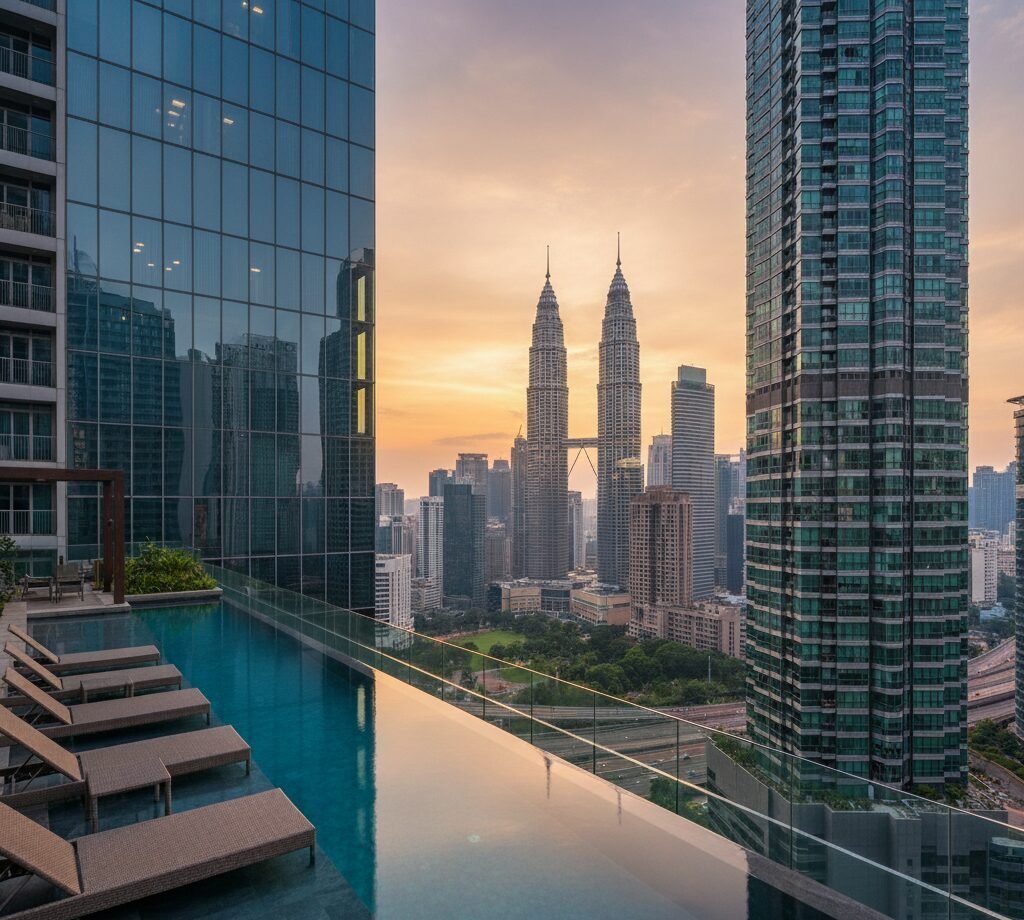
Table of Contents
- KLCC Market Overview 2026: Price Bands, Volumes, Overhang
- Four Seasons Place Residences: The Benchmark
- The Troika: Architectural Icon, Value Play
- Binjai on the Park: The Petronas View Premium
- Stonor Park: The Yield Specialist
- 8 Conlay: The New Entry
- Side-by-Side Comparison: All Five Projects
- Price History 2013–2026: The Full Cycle
- Tenant Profiles: Who Rents at KLCC and Why
- Rental Yield Projections 2026–2028
- Verdict: Which Project for Which Investor
- FAQ
1. KLCC Market Overview 2026: Price Bands, Volumes, Overhang
The KLCC residential market in 2026 is best understood as two distinct sub-markets operating within the same postcode. The first is the established freehold trophy segment — projects completed between 2008 and 2017 with strong brand recognition, institutional-quality management, and a proven transaction record. The second is the emerging new supply layer — projects launched at RM 1,700–3,000/sqft that are still under construction or recently handed over, targeting a premium that must be justified by scarcity and delivery quality over time.
In the trophy segment, median transacted prices across KLCC’s leading freehold condominiums range from RM 1,393 to RM 2,072/sqft based on Q4 2025 Brickz transaction data. The headline figure from iProperty shows the median transaction price at Four Seasons Place at RM 3,010/sqft — the outlier at the ultra-premium end — while Binjai on the Park transacts at a median of RM 2,072/sqft and The Troika occupies the RM 700–1,300/sqft band for secondary market stock. This spread is not a sign of market incoherence; it reflects the genuine quality and brand tiering within what outsiders treat as a single “KLCC market.”
Overhang in the KLCC area — unsold completed units — sits at approximately 2,287 units across Greater KL’s luxury segment above RM 1M, per NAPIC Q3 2025. The concentration is in older serviced apartments and non-branded stock in the RM 600–900/sqft tier. The specific projects analysed in this article — Four Seasons, The Troika, Binjai, Stonor Park — are not materially exposed to this overhang, as their resale markets are driven by secondary transactions between informed buyers rather than developer-held unsold stock. Foreign buyers represent the primary purchaser profile at the top of this market: the RM 1M minimum threshold for foreign buyers effectively directs all foreign capital into the trophy segment by default.
2. Four Seasons Place Residences: The Benchmark
Developer: Venus Assets Sdn Bhd (owned by Tan Sri Syed Yusof Syed Nasir, the Sultan of Selangor, and Singapore-based hotelier Ong Beng Seng) | Completed: 2017 | Tenure: Freehold | Units: 240 (140 residential + 100 serviced residences) | Address: 145 Jalan Ampang, KLCC
Four Seasons Place is Malaysia’s only true five-star branded residence — a category that commands a structural premium globally and has proven its staying power at the top of KLCC’s market since completion. The development sits directly adjacent to the Petronas Twin Towers, sharing a masterplan with the Four Seasons Hotel KL and Shoppes at Four Seasons Place. Residents have access to full hotel-level services: 24-hour concierge, valet, in-residence private dining, limousine, housekeeping, personal trainer, and wine curation — services that are genuinely delivered (not promised in a brochure) through the Four Seasons brand’s operational presence in the building.
Pricing (2025–2026 transactions): The median transacted price is RM 3,010/sqft, making it by a significant margin the most expensive residential product in Malaysia’s secondary market. The most popular unit is a 2-bedroom at 1,345 sqft with a recent median of RM 2,830/sqft — entry at approximately RM 3.8M. The 4-bedroom at 3,843 sqft trades at RM 3,640/sqft, implying a total value of RM 14M+. New listings start from RM 4,725,000 for approximately 1,611 sqft. The GDV of the entire development is approximately RM 2.8 billion.
Rental performance: Current gross rental yield is 4.24% (iRumah 2025 data), up from 3.95% in 2024 and the highest recorded since the property’s 2018 low of 3.47%. This represents a meaningful recovery from the COVID-era yield compression. At RM 3,010/sqft median, a 2-bedroom at 1,345 sqft valued at approximately RM 4M would generate gross rental income of approximately RM 169,600/year (RM 14,133/month) — consistent with market listings showing 2-bedroom units renting at RM 12,000–16,000/month for fully furnished, managed units.
Maintenance fees: RM 1.00–1.50/sqft/month, one of the highest in KLCC but justified by the Five-Star service package. A 1,345 sqft unit carries approximately RM 16,140–24,210/year in maintenance — a significant cost that reduces net yield to approximately 3.0–3.5% net of fees and vacancy. This is the price of the brand.
Investment profile: Four Seasons is a prestige and capital preservation play, not a yield optimisation vehicle. Its 14% capital growth figure (iProperty) and the recovery in yields to a decade-high suggests the market is repricing it appropriately after COVID-era disruption. For investors with RM 4M+ to commit, it remains the most liquid exit in KL’s luxury market — branded residences globally have proven easier to sell to the next HNW buyer than generic luxury stock.
3. The Troika: Architectural Icon, Value Play
Developer: Bandar Raya Developments Berhad (BRDB) | Completed: 2010 | Tenure: Freehold | Units: 229 across three towers (38, 44, 55 storeys) | Architect: Foster + Partners (Norman Foster) | Address: Persiaran KLCC / Jalan Binjai
The Troika is the most architecturally distinctive residential development in KLCC — and arguably in all of Malaysia. Designed by the same practice behind the Gherkin in London and the Reichstag in Berlin, its three towers feature a “twisting building” concept that rotates floors as the building rises, optimising views of the Petronas Twin Towers from every level. The sky lobby connecting all three towers via glass-encased bridges won multiple international awards including the CNBC Best International High-Rise Architecture. For Western buyers who understand architectural pedigree, The Troika’s Foster + Partners provenance is a genuine differentiator that the KL market has historically underpriced relative to global equivalents.
Pricing (2025–2026): The Troika occupies a distinctive position — significantly below Four Seasons and Binjai on a per-sqft basis, yet definitively in the KLCC trophy tier. Current secondary market listings start from RM 1,600,000 (SoHo units from approximately 960 sqft at RM 780–1,200/sqft) through to standard 3-bedroom units at RM 2,000–3,336 sqft in the RM 900–1,300/sqft range. Penthouses — the most famous product in the building, ranging up to 21,688 sqft — trade at premium pricing for their category. The average asking price band across all stock on iProperty is RM 700–1,300/sqft for completed secondary transactions, confirmed by EdgeProp’s KLCC area data.
Rental performance: Standard 3-bedroom units of 2,200–2,800 sqft rent for RM 8,000–14,000/month based on current agent listings, with penthouses commanding RM 20,000–35,000/month for exceptional floors. At a mid-tier entry of RM 2.5M for a 2,500 sqft 3-bedroom (RM 1,000/sqft), gross yield at RM 10,000/month is approximately 4.8% — meaningfully above Four Seasons on the same metric. Net yield after maintenance (approximately RM 0.90/sqft/month = RM 27,000/year), vacancy allowance (8%), and management fees reaches approximately 3.5–4.0% — the best net yield profile among KLCC’s top-tier developments for value-oriented investors.
Maintenance fees: RM 0.80–1.00/sqft/month — lower than Four Seasons and Binjai, reflecting the absence of a hotel operator but still comprehensive in terms of security, landscaping, and facilities management. The sky bridges and sky lobby require ongoing structural maintenance that is factored into the higher end of this range.
Investment profile: The Troika is KLCC’s most compelling value proposition for the sophisticated investor who understands architectural rarity. At RM 900–1,300/sqft versus Four Seasons at RM 2,830–3,640/sqft, the discount to the trophy benchmark is approximately 60–70%. The Foster + Partners pedigree, the freehold tenure, and the intimate 229-unit scale (two units per floor in standard apartments) combine to create a product whose global comparables — Norman Foster residential buildings in London, New York, and Hong Kong — trade at a significant premium to generic luxury stock in the same markets. The KLCC market has not yet fully repriced The Troika for its architectural heritage value.
4. Binjai on the Park: The Petronas View Premium
Developer: KLCC Property Holdings Berhad (the property arm of Petronas, via KLCC Holdings) | Completed: 2008 | Tenure: Freehold | Units: 171 | Address: Jalan Binjai / KLCC Park perimeter
Binjai on the Park occupies the single most coveted residential site in KLCC: directly adjacent to KLCC Park, with an unobstructed view of the Petronas Twin Towers that is permanently protected by development controls. The developer is KLCC Property Holdings — effectively the Petronas Group’s property subsidiary, which also owns and manages Suria KLCC, Menara Maxis, and Petronas Tower 3. The ownership structure means Binjai’s amenities, management standards, and site maintenance are governed by the same organisation that manages the Petronas Twin Towers — an institutional quality guarantee that no private developer can replicate.
A defining operational feature is the private buggy service connecting Binjai residents directly to the Petronas Twin Towers via KLCC Park — eliminating the heat and distance that make pedestrian access impractical in KL’s tropical climate. For corporate tenants whose offices are in the Twin Towers or KLCC-adjacent Grade A towers, this is a functional advantage that directly supports tenancy decisions and premium rents.
Pricing (2025–2026 Brickz transactions): 19 transactions recorded between February 2024 and January 2025. Median transaction price: RM 5,750,000 at RM 1,867/sqft median. Price range P25–P75: RM 3,600,000 to RM 9,200,000. iProperty confirms the median transacted price at RM 2,072/sqft, reflecting the full transaction sample including older lower-floor stock. Current asking prices on PropertyGuru: RM 1,616–3,236/sqft with total unit prices from RM 3,600,000 to RM 23,300,000. iRumah reports capital growth of 14.04% — the highest of any project in this analysis.
Rental performance: iRumah records the current gross rental yield at 2.56%, reflecting the very high absolute purchase prices relative to achievable rents. Current rental listings start from RM 15,000/month for a 2,228 sqft unit. At RM 5.28–7.62/sqft/month on rent (iProperty data), a 3,000 sqft unit generates RM 15,840–22,860/month. Gross yield on a RM 7M entry purchase at RM 20,000/month rent is approximately 3.4% — modestly below Four Seasons gross yield but with significantly stronger capital appreciation credentials.
Maintenance fees: RM 1.00–1.40/sqft/month, reflecting the KLCC Property Holdings institutional management standard. For a 3,000 sqft unit, annual maintenance sits at RM 36,000–50,400 — the second highest in this analysis after Four Seasons.
Investment profile: Binjai is the capital appreciation specialist. The permanently protected Twin Towers view, the institutional developer/manager, the Petronas Group association, and the deepest liquidity of any residential property in Malaysia (the institutional buyer pool for an asset backed by Petronas brand credentials is global) combine to make Binjai the most credible long-hold, capital gains asset in KLCC. At 14.04% recorded capital growth and a RM 1,867/sqft median transaction, it has demonstrated appreciation that neither The Troika nor Stonor Park has matched. The tradeoff is entry price and yield compression.
5. Stonor Park: The Yield Specialist
Developer: Beneton Properties Sdn Bhd | Completed: 2006 | Tenure: Freehold | Units: Not disclosed (mid-rise) | Address: Jalan Stonor, KLCC
Stonor Park is KLCC’s best-kept secret for yield-focused investors. Developed in 2006 at a launch price of approximately RM 500/sqft, it now trades at current market prices that reflect its mature, post-cycle position: older build quality relative to Four Seasons or Binjai, but a fundamentally sound KLCC address with the same access to the LRT network, the same proximity to Grade A office towers, and a substantially lower entry price that generates better income returns.
Pricing: Current market pricing in the RM 700–1,000/sqft range, confirmed by EdgeProp KLCC area data. This places Stonor Park at approximately one-third of Four Seasons’ per-sqft price. Entry from approximately RM 1.5M–2.5M for a 2–3 bedroom unit — within the RM 1M foreign buyer minimum threshold but at the most accessible price point of any true KLCC freehold product in this analysis.
Rental performance: iRumah records the current gross rental yield at 3.58%, up from 3.27% in 2023 — a trend consistent with the broader KLCC yield recovery. This is the highest gross yield of any project in this analysis at the trophy tier. At RM 700–1,000/sqft entry on a 2,000 sqft unit (RM 1.4M–2M), monthly rent of RM 6,000–8,000 generates a gross yield of approximately 4.0–5.1% — materially above the 4.24% maximum achieved by Four Seasons at a much lower absolute entry price.
Maintenance fees: RM 0.50–0.70/sqft/month — the lowest of any project in this analysis, reflecting the older build and simpler amenities structure. Net yield after all deductions is approximately 3.2–4.0% — competitive with any KLCC project and superior to most on a net basis.
Investment profile: Stonor Park is for the investor prioritising income return over prestige branding, for whom the KLCC address and freehold tenure provide the investment-grade foundation and annual cashflow is the primary objective. The building’s age creates maintenance risk that must be factored — older high-rises in KL require periodic major spending on lifts, electrical systems, and waterproofing. Conduct a thorough building inspection and review the management corporation’s maintenance fund reserve before purchase.
6. 8 Conlay: The New Entry
Developer: KSK Land | Status: Completed / completing phases 2025–2026 | Tenure: Freehold | Address: Jalan Conlay, KLCC (adjacent to Pavilion KL)
8 Conlay is the newest significant entrant in KLCC’s luxury residential market — a YOO-branded development in three towers whose YOO Residences component features interiors curated by Philippe Starck. EdgeProp confirms the launch pricing in the RM 1,700–3,000/sqft range, positioning it directly between The Troika at the lower end and Four Seasons at the top. The Pavilion KL direct connectivity, the YOO brand’s global appeal to design-conscious HNW buyers, and freehold tenure on a newly completed product make it the freshest premium option in the market.
Pricing: Launch prices RM 1,700–2,200/sqft for the YOO Residences component. Secondary market pricing remains thin given recent completion, but early resale listings are appearing in the RM 1,800–2,400/sqft range. Entry from approximately RM 2.5M–5M depending on floor and configuration.
Rental potential and risk: Given recent completion, the rental yield track record is limited to 12–18 months of live data. Projected gross yields of 3.5–4.5% are reasonable based on comparable newly completed KLCC stock, but the yield must be stress-tested against the delivery of the full mixed-use element (retail, hotel) that generates the pedestrian ecosystem supporting rental demand. New developments carry vacancy risk in the first 12–24 months as the building stabilises and management establishes its operating rhythm. 8 Conlay carries higher short-term uncertainty than the established projects in this analysis, offset by newer build quality and the YOO brand premium.
7. Side-by-Side Comparison: All Five Projects
| Project | Completed | Tenure | Units | Price Range (RM/sqft) | Entry (RM) | Gross Yield | Maint. Fee (/sqft/mth) | Capital Growth | Liquidity |
|---|---|---|---|---|---|---|---|---|---|
| Four Seasons Place | 2017 | Freehold | 240 | 2,830–3,640 | RM 3.8M+ | 4.24% | RM 1.00–1.50 | Moderate | ★★★★★ |
| Binjai on the Park | 2008 | Freehold | 171 | 1,688–3,187 | RM 3.6M+ | 2.56% | RM 1.00–1.40 | 14.04% ★ | ★★★★★ |
| The Troika | 2010 | Freehold | 229 | 780–1,300 | RM 1.6M+ | ~4.5–5.0%* | RM 0.80–1.00 | Moderate | ★★★★☆ |
| Stonor Park | 2006 | Freehold | n/a | 700–1,000 | RM 1.5M+ | 3.58% | RM 0.50–0.70 | Low-moderate | ★★★☆☆ |
| 8 Conlay (YOO) | 2025 | Freehold | n/a | 1,700–2,400 | RM 2.5M+ | est. 3.5–4.5% | est. RM 0.90–1.20 | TBD | ★★★☆☆ |
8. Price History 2013–2026: The Full Cycle
Understanding where KLCC prices sit in their historical cycle is essential context for any entry decision in 2026. The data from Savills, EdgeProp, and NAPIC tells a coherent story of boom, correction, and measured recovery.
2001–2013: The formation of the market. Savills data shows that KLCC condominiums (Corinthian, Marc Service Residence, Park View, Stonor Park) averaged RM 500,000 per unit in 2001. By 2008, transactions had crossed RM 1M. By 2017, the median transaction had reached RM 1.12M — a 123% appreciation over 16 years in nominal terms. The period 2010–2013 represented the peak of speculative demand, with KLCC prices hitting all-time highs fuelled by Chinese buyer interest and REIT-like institutional demand for trophy residential.
2013–2019: The correction. KLCC residential prices peaked in 2013 and entered a prolonged correction. Oversupply from the mid-2010s pipeline — particularly in serviced apartments and smaller format stock — created downward pressure that affected the luxury segment through contagion even where direct oversupply was not the issue. EdgeProp reports that prices in this period declined 5–14% depending on product type. The Troika, as a 2010 completion, experienced the full downcycle and saw its secondary market prices compress significantly from launch levels.
2020–2022: COVID disruption. The closure of Malaysia’s borders from March 2020 to April 2022 removed the expatriate tenant base that underpins KLCC rental demand. Yields collapsed — Four Seasons reached its record-low 3.47% gross yield in 2018 (pre-COVID pressure) and remained suppressed through 2021–2022. Transaction volumes contracted. Binjai, with its Petronas Group backing, proved more resilient to yield compression than privately managed buildings.