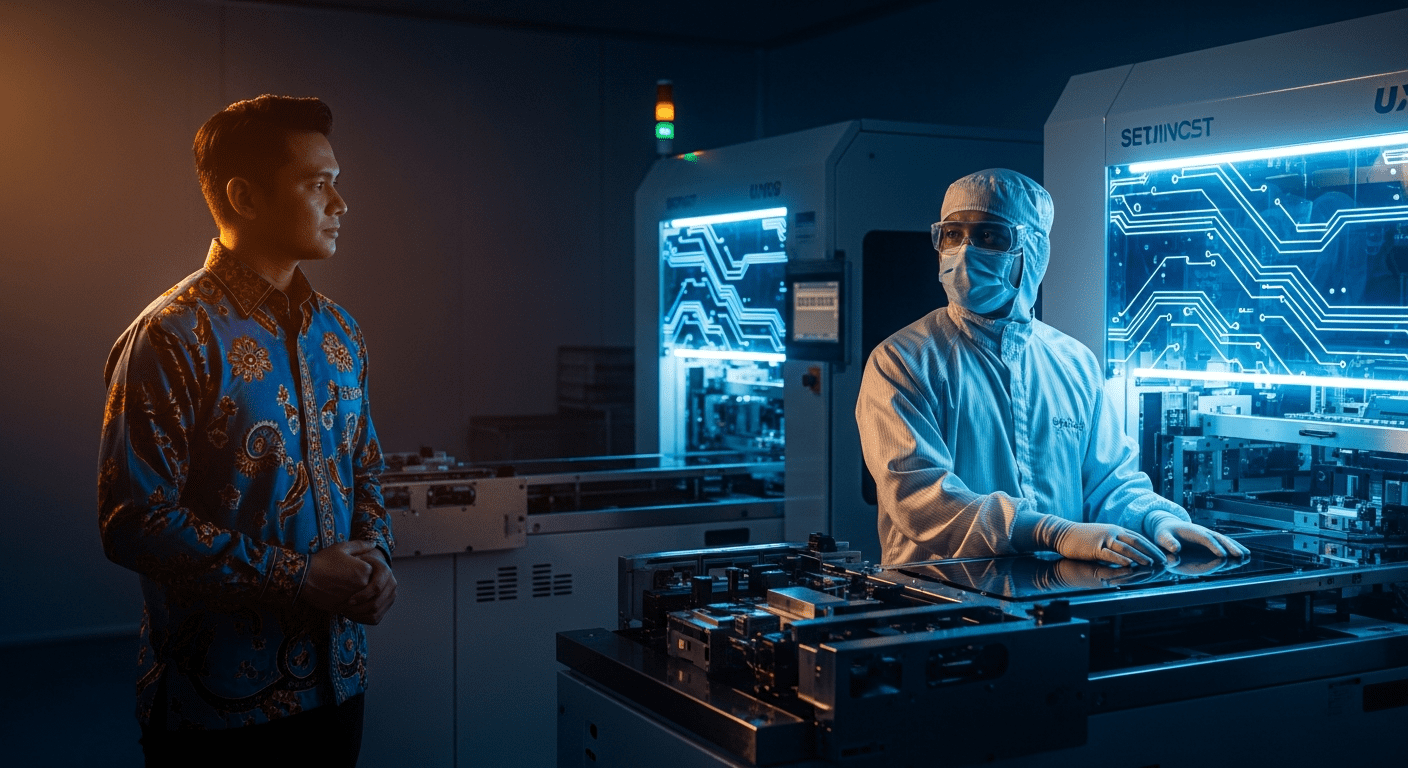
Frontken Corporation: Semiconductor Stock Analysis for HNW Investors
“`html
Frontken Corporation: Semiconductor Services Stock Analysis for International Investors
Malaysia’s semiconductor industry has quietly emerged as a critical node in global chip manufacturing, accounting for approximately 13% of worldwide backend assembly and test services. For Western high-net-worth investors seeking exposure to this growth trajectory beyond the overvalued giants of Taiwan and South Korea, Frontken Corporation presents a compelling proposition. This mid-cap specialist in precision engineering and surface treatment services for semiconductor manufacturers trades on Bursa Malaysia at valuations that often puzzle investors accustomed to premium tech multiples in developed markets.
Frontken’s story combines strategic positioning within Southeast Asia’s expanding manufacturing ecosystem with tangible financial performance that warrants serious evaluation. Unlike headline-grabbing chipmakers, this company operates in the essential but less glamorous realm of equipment refurbishment, precision components, and surface finishing—services that become increasingly vital as semiconductor nodes shrink and fabrication complexity escalates. For diversification-minded investors, Frontken offers a differentiated entry point into the Malaysian stock market with sector-specific growth drivers that transcend domestic economic cycles.
This analysis provides the comprehensive due diligence framework you need, from financial ratio dissection to practical account opening procedures, taxation nuances, and transparent risk assessment. Whether you’re exploring Malaysian equities for the first time or refining your Asia-Pacific portfolio allocation, understanding Frontken’s competitive positioning requires examining both company-specific fundamentals and the broader industry dynamics reshaping regional manufacturing.
The Global and Malaysian Semiconductor Landscape: Tailwinds for Frontken
The global semiconductor market reached USD 574 billion in 2023 and continues expanding despite cyclical volatility, driven by artificial intelligence, electric vehicles, 5G infrastructure, and IoT proliferation. This growth creates sustained demand not just for chips themselves, but for the entire support ecosystem—equipment maintenance, precision tooling, surface treatment, and component refurbishment. Companies like Frontken occupy this critical but often overlooked segment, providing services that extend equipment lifespan and maintain production quality at fabrication facilities.
Malaysia’s semiconductor industry employs over 500,000 workers and contributes approximately 7% to national GDP, according to Malaysian Investment Development Authority (MIDA) data. The country hosts operations from Intel, Infineon, Texas Instruments, and numerous assembly/test houses, creating a dense supplier network. Unlike Singapore’s higher-cost environment or Vietnam’s emerging but less mature infrastructure, Malaysia offers the ideal balance of technical workforce availability, established industrial ecosystems, and competitive operating costs.
Frontken benefits directly from this concentration. When semiconductor manufacturers in Penang, Kulim, or Johor require precision component fabrication, equipment refurbishment, or specialized surface treatments, they increasingly turn to domestic providers rather than shipping to Taiwan or Singapore. The company’s geographic proximity to major fabrication plants reduces turnaround times—a critical factor when equipment downtime costs can exceed USD 100,000 per hour at advanced facilities. This localization trend accelerated post-pandemic as supply chain resilience became a strategic priority for multinational semiconductor corporations.
Semiconductor Services vs. Chipmaking: Understanding Frontken’s Niche
Frontken does not manufacture semiconductors. Instead, it provides essential services to those who do. The company’s precision engineering division produces custom components for semiconductor equipment—vacuum chambers, gas delivery systems, precision fixtures. Its surface treatment services include electroplating, anodizing, and specialized coatings that enhance equipment durability and maintain contamination-free production environments. A third segment focuses on equipment refurbishment, restoring used semiconductor manufacturing tools to near-original specifications at 40-60% of new equipment costs.
This business model offers inherent advantages. Capital intensity remains lower than chipmaking, with typical capital expenditure running 8-12% of revenue versus 25-35% for semiconductor foundries. The customer base diversifies across multiple chipmakers and equipment manufacturers, reducing single-client concentration risk. Moreover, semiconductor equipment refurbishment becomes particularly attractive during industry downturns when manufacturers postpone major capital purchases but still require maintenance and upgrades—providing a degree of countercyclical stability.
Frontken Corporation’s Business Model and Competitive Edge
Founded in 1996 and listed on Bursa Malaysia’s ACE Market before graduating to the Main Market in 2017, Frontken has evolved from a pure surface treatment provider into an integrated semiconductor services company. Its operations span four facilities in Malaysia (Penang, Melaka) and international locations in Singapore and China. This geographic footprint positions the company within proximity to major semiconductor clusters while maintaining cost-competitive Malaysian operations as its primary base.
The company’s revenue composition demonstrates balanced diversification. Precision engineering typically contributes 45-50% of revenue, surface treatment 30-35%, and equipment refurbishment 15-20%. This mix provides stability—when new fabrication investments slow (reducing precision component demand), existing facilities increase maintenance spending (boosting refurbishment revenue). Customer relationships with multinational corporations including Infineon, Texas Instruments, and Kulicke & Soffa create recurring revenue streams, as these clients standardize on approved vendors for quality-critical services.
Technological Capabilities and Barriers to Entry
Frontken’s competitive moat stems from accumulated technical expertise and certification requirements. Semiconductor manufacturers impose stringent vendor qualification processes lasting 12-24 months, evaluating quality systems, contamination control protocols, and process consistency. Once approved, switching costs become substantial—requalifying alternative suppliers risks production delays and quality issues. The company maintains ISO 9001, ISO 14001, and IATF 16949 certifications, meeting automotive-grade quality standards that increasingly apply to power semiconductors for electric vehicles.
The company invests approximately 2-3% of revenue in R&D, focusing on advanced coating technologies for next-generation equipment and automation to improve process consistency. While this R&D intensity appears modest compared to chipmakers’ 15-20% spend, it aligns appropriately with Frontken’s services business model. Recent developments include plasma-enhanced chemical vapor deposition (PECVD) coatings for 300mm wafer processing equipment and specialized cleaning protocols for extreme ultraviolet (EUV) lithography components—positioning the company for higher-margin advanced node services.
In-Depth Financial Analysis: Performance, Valuation, and Growth Prospects
Understanding Frontken’s investment merits requires examining both historical performance and forward-looking metrics. The company’s five-year financial trajectory reveals consistent growth punctuated by semiconductor industry cyclicality—a pattern you must internalize when evaluating appropriate entry points and holding period expectations.
Historical Revenue and Profit Growth
From fiscal years 2018 to 2023, Frontken achieved revenue compound annual growth of approximately 12.8%, expanding from RM 187 million to RM 342 million. This outpaced Malaysia’s GDP growth (averaging 4.2% over the same period) and reflected both market share gains and industry expansion. Net profit growth proved more volatile at 15.3% CAGR, demonstrating operational leverage as the company absorbed fixed costs across growing revenue. Notably, fiscal 2023 saw net profit reach RM 38.6 million, up 22% year-over-year despite broader semiconductor industry headwinds.
Operating margins have improved from 13.5% in 2018 to approximately 16.8% in 2023, reflecting efficiency gains from automation investments and a strategic shift toward higher-margin precision engineering work. Return on equity (RoE) averaged 17.2% over the five-year period—respectable for industrial services but below software-like returns, appropriately reflecting the capital-intensive nature of manufacturing operations. Debt-to-equity ratio remained conservative at 0.32 times, providing financial flexibility for expansion without overleveraging the balance sheet.
Key Financial Ratios and Valuation Metrics
| Metric | Frontken Corporation | Bursa Tech Index Avg | Regional Peers (SGX/TWSE) |
|---|---|---|---|
| P/E Ratio (TTM) | 11.2x | 18.5x | 15.8x |
| P/B Ratio | 1.8x | 2.4x | 2.2x |
| EV/EBITDA | 7.4x | 11.2x | 9.6x |
| Dividend Yield | 3.8% | 2.1% | 2.7% |
| RoE (5-year avg) | 17.2% | 14.8% | 16.5% |
Frontken’s valuation multiples trade at notable discounts to both Malaysian technology peers and regional comparables. The P/E ratio of 11.2x compares favorably against Singapore-listed semiconductor services companies averaging 15-16x and Taiwan precision component manufacturers at 14-18x. This discount partially reflects liquidity differences—Bursa Malaysia mid-caps naturally trade below Singaporean or Taiwanese large-caps—but also presents potential value for patient investors willing to accept lower trading volumes.
The price-to-book ratio of 1.8x suggests moderate valuation relative to tangible assets, appropriate for a capital-intensive business with specialized equipment. Comparatively, U.S.-listed precision manufacturing companies often trade at 3-4x book value, though they typically serve higher-margin aerospace and medical device markets. Frontken’s EV/EBITDA multiple of 7.4x implies the market assigns relatively modest premiums to future cash generation—potentially underappreciating the company’s position in a structurally growing industry.
Dividend Policy and Yield for Foreign Shareholders
What is Frontken Corporation’s current dividend yield and payout policy for foreign investors? The company has maintained consistent dividend distributions with payout ratios ranging from 35% to 45% of net profit. Based on recent trading prices around RM 1.85 per share and annual dividends of approximately 7 sen per share, the dividend yield approximates 3.8%—attractive compared to developed market technology stocks but modest relative to Malaysian REITs or utility companies.
For foreign investors, Malaysian dividend taxation proves favorable. Non-resident shareholders face zero withholding tax on dividends from Malaysian companies, as Malaysia operates a single-tier tax system where corporate profits are taxed at the company level (24% standard corporate tax rate) and dividends flow through tax-free to shareholders. This contrasts sharply with markets like the United States (30% withholding for non-treaty residents) or Indonesia (20% withholding), making Malaysian equities particularly tax-efficient for international portfolios.
Dividend payment typically occurs semi-annually, with amounts distributed directly to your Central Depository System (CDS) account and convertible to foreign currency through standard banking channels. The combination of moderate yield, zero withholding tax, and potential capital appreciation creates a compelling total return profile, particularly for investors from high-tax jurisdictions who can claim foreign tax credits for corporate-level Malaysian taxation under relevant Double Taxation Agreements.
Growth Drivers and Analyst Perspectives
What are the key growth drivers for Frontken Corporation in the next 3-5 years, particularly from advanced packaging or new technologies? Several catalysts support continued expansion. First, the global shift toward advanced packaging technologies—chiplet integration, fan-out wafer-level packaging, 3D stacking—requires more sophisticated precision components and tighter contamination control, playing to Frontken’s capabilities. Second, Malaysia’s push to move up the semiconductor value chain beyond assembly/test into more advanced manufacturing creates local opportunities as companies like Intel expand Malaysian operations.
Third, the equipment refurbishment segment should benefit from semiconductor industry cyclicality. During downturns, chipmakers prioritize extending existing equipment life over purchasing new tools—potentially increasing refurbishment revenue even as new precision component demand softens. Fourth, Frontken’s expansion into China (despite geopolitical complexities) positions it to serve the world’s largest semiconductor market, where domestic manufacturers face restricted access to Western equipment and increasingly seek qualified regional service providers.
Analyst coverage remains limited—a characteristic of Malaysian mid-caps—but available research suggests consensus earnings growth of 10-14% annually over the next three years, supported by Malaysia’s semiconductor manufacturing expansion and Frontken’s capacity additions. Price targets from local brokerages range from RM 2.10 to RM 2.50, implying 13-35% upside potential from recent trading levels around RM 1.85, though you should view single-analyst projections with appropriate skepticism and focus instead on business fundamentals.
Investing in Frontken: A Practical Guide for Western HNWs
What is the process and associated costs for a foreign HNW investor to open a brokerage account and purchase Malaysian stocks like Frontken? Accessing Bursa Malaysia as an international investor requires navigating several administrative steps, but the process proves straightforward with proper guidance and documentation. You have two primary pathways: engaging international brokers with Malaysian market access or establishing accounts directly with Malaysian brokerage firms.
International Broker Route
Several international brokerages offer Malaysian stock market access, including Interactive Brokers, Saxo Bank, and certain private bank platforms. This approach provides familiar interfaces, consolidated reporting across multiple markets, and simplified tax documentation. However, you’ll typically face higher brokerage commissions (0.40-0.80% per trade) compared to local Malaysian brokers, plus potential currency conversion spreads of 0.3-0.6% on MYR transactions. Minimum account sizes usually start at USD 10,000, though HNW desks may require USD 100,000+ for dedicated service.
The key advantage lies in operational simplicity—your existing broker relationship extends to Malaysian markets without requiring separate Malaysian banking infrastructure. Most international platforms provide research access, real-time quotes, and seamless integration with your broader portfolio. The disadvantage centers on costs and occasionally limited access to smaller Bursa Malaysia listings, though Frontken’s Main Market status ensures availability across major platforms.
Local Malaysian Broker Approach
Establishing a direct relationship with a Malaysian brokerage firm (such as Kenanga, RHB, or CIMB) typically delivers lower trading costs (0.20-0.42% per trade) and direct market access without intermediary layers. The process requires opening both a brokerage trading account and a CDS (Central Depository System) account—Malaysia’s electronic share registry system that records your beneficial ownership of securities.
Documentation requirements include valid passport, proof of residential address (utility bill or bank statement within three months), and completion of know-your-customer (KYC) forms detailing investment experience and source of funds. Processing typically takes 5-10 business days once complete documentation reaches the broker. Some Malaysian brokers now offer fully digital onboarding with video verification, though HNW clients often prefer in-person relationship establishment when visiting Malaysia for property or business due diligence.
Foreign Ownership Regulations and Restrictions
Are there any foreign ownership restrictions or limits on acquiring shares in Frontken Corporation for non-Malaysian citizens? Malaysia imposes no general foreign ownership restrictions on publicly listed companies, differentiating it favorably from markets like Thailand (49% foreign limits in certain sectors) or Indonesia (varying sector-specific caps). You can acquire Frontken shares with identical rights and pricing as Malaysian citizens, and foreign shareholding in the company currently sits around 8-12%—indicating room for additional international investment without approaching any informal thresholds.
Certain strategic sectors face foreign investment limitations (defense, media, specific resource extraction), but technology and manufacturing services remain fully open. Securities Commission Malaysia maintains oversight of public markets with regulations aligned to international standards, providing reasonable investor protections. The absence of foreign exchange controls on capital account transactions means you can freely repatriate investment proceeds and dividends, subject only to standard anti-money laundering documentation for large transfers.
Capital Mobilization and Trade Execution
Funding your Malaysian brokerage account requires international wire transfer in USD, EUR, or GBP, which the broker or custodian bank converts to MYR at prevailing rates. Expect currency conversion costs of 0.4-0.8% depending on transfer size and negotiated rates. Larger transfers (USD 100,000+) warrant requesting competitive FX quotes from multiple providers, as spreads vary significantly. Some Malaysian banks offer forward contracts or spot-next arrangements to hedge currency exposure if you’re planning staggered purchases.
Once funds clear (typically 2-3 business days for international wires), you can place orders during Bursa Malaysia trading hours: 9:00 AM to 5:00 PM Malaysia time (GMT+8), with a midday break from 12:30-2:30 PM. Frontken’s average daily trading volume approximates 400,000-800,000 shares, translating to roughly RM 750,000-1.5 million daily liquidity. For reference, accumulating a RM 500,000 position (approximately USD 110,000) might require 2-4 trading days to avoid materially impacting the stock price—a reminder that Malaysian mid-caps demand patient execution compared to S&P 500 liquidity.
Taxation Implications for International Investors in Malaysian Stocks
What are the tax implications (e.g., withholding tax on dividends, capital gains tax) for a US or UK-based investor holding Frontken Corporation shares? Understanding cross-border tax treatment proves crucial for accurate return projections and compliance. Malaysia’s tax framework for non-resident investors contains several advantageous features, though you must coordinate with your home country’s tax obligations.
Dividend Taxation: The Single-Tier Advantage
Malaysian withholding tax on dividends: rates and exemptions create a highly favorable environment. Under Malaysia’s single-tier corporate tax system, companies pay corporate tax (standard rate: 24%) on profits, and dividends distributed to shareholders carry no additional tax—regardless of shareholder residency. This means you receive Frontken’s dividends gross, without Malaysian withholding deductions. The effective tax burden remains the 24% already paid at the corporate level, embedded in the company’s earnings from which dividends derive.
This contrasts with classical double taxation systems. In the United States, for example, corporations pay federal tax (21%) on profits, then shareholders pay additional tax on dividends received (up to 37% for ordinary dividends or 20% for qualified dividends). By eliminating shareholder-level taxation, Malaysia’s system effectively provides tax relief of 10-15 percentage points compared to double-taxation jurisdictions, enhancing net returns for foreign investors.
Capital Gains Tax: Non-Existent for Non-Residents
Absence of capital gains tax for non-residents on Malaysian shares represents perhaps the most compelling tax feature. Malaysia imposes no capital gains tax on gains from disposal of shares for non-resident individuals. Whether you sell Frontken at a 20% profit or 200% profit, the entire gain remains untaxed in Malaysia. This applies regardless of holding period—no distinction exists between short-term and long-term gains as in U.S. tax code.
The only exceptions involve real property gains tax (RPGT, applicable to Malaysian real estate but not securities) and specific situations involving trading activities so frequent they’re deemed a business rather than investment. For typical HNW investors purchasing and holding equity positions, capital gains escape Malaysian taxation entirely. You must, however, account for these gains under your home country’s tax regime, where treatment varies significantly.
Leveraging Double Taxation Agreements
Malaysia maintains comprehensive Double Taxation Agreements (DTAs) with over 70 countries, including the United States, United Kingdom, most EU members, Singapore, and Hong Kong. These treaties primarily address dividend and interest income taxation, though since Malaysia already imposes zero dividend withholding, the practical benefit flows to your home country treatment. Inland Revenue Board of Malaysia (LHDN) provides official treaty texts for detailed review.
For U.S. investors, the Malaysia-U.S. DTA confirms Malaysian dividend taxation doesn’t exceed rates specified (though Malaysia’s zero rate already complies), and allows U.S. taxpayers to claim foreign tax credits for corporate-level Malaysian tax paid by Frontken—though calculating the precise credit amount involves complex “gross-up” calculations best handled by international tax advisors. U.K. investors under the U.K.-Malaysia DTA face similar provisions, with Malaysian-source dividends typically qualifying for foreign tax credit relief against U.K. tax obligations.
Critically, capital gains on share sales remain taxable in your country of residence under most DTAs, as Malaysia doesn’t exercise primary taxation rights. U.S. investors face long-term capital gains rates (0%, 15%, or 20% depending on income) on shares held over one year. U.K. investors currently face capital gains tax at 10% or 20% (depending on total taxable income), with annual exemption allowances (£3,000 for 2024/25). These home country obligations underscore the importance of coordinating Malaysian investments within your overall tax planning strategy.
Reporting Requirements and Compliance
Your home country likely imposes reporting requirements for foreign financial accounts and assets. U.S. taxpayers must report foreign financial accounts exceeding USD 10,000 aggregate value via FinCEN Form 114 (FBAR) and potentially Form 8938 (FATCA) if thresholds exceed USD 50,000-200,000 depending on filing status and residence. Malaysian brokerage accounts holding Frontken shares fall within these requirements. U.K. taxpayers face similar obligations under Common Reporting Standard (CRS) automatic exchange of information, though specific filing forms vary.
Failure to comply with reporting requirements carries substantial penalties disproportionate to any tax owed, making proper documentation essential. Engage qualified cross-border tax advisors familiar with both Malaysian source income and your home country’s foreign investment reporting regime. The additional compliance costs (typically USD 500-2,000 annually for professional preparation) form part of your investment’s all-in expense structure and should factor into return expectations for smaller positions.
Risks and Mitigations: A Transparent Outlook on Frontken Investment
What are the specific risks associated with investing in Frontken Corporation, including cyclicality of the semiconductor industry, geopolitical tensions, or currency fluctuations (MYR)? Comprehensive risk assessment separates sophisticated investors from those chasing returns without understanding downside scenarios. Frontken’s investment profile contains several material risks demanding honest evaluation and appropriate mitigation strategies.
Semiconductor Industry Cyclicality and Demand Volatility
The semiconductor sector operates through pronounced boom-bust cycles, typically spanning 3-5 years, driven by inventory fluctuations, technological transitions, and macroeconomic conditions. During downturns (as experienced in 2019 and again in 2023), chip demand contracts sharply, triggering 20-30% revenue declines across supply chains. Frontken’s services business provides some insulation—equipment refurbishment often increases during downturns—but cannot fully escape industry dynamics. Investors must anticipate periodic earnings volatility of 15-25% and potentially declining stock prices during semiconductor oversupply periods.
Mitigation involves treating Frontken as a long-term holding (5+ year horizon) and sizing positions to withstand interim volatility. Consider dollar-cost averaging during accumulation phases to smooth entry prices across different cycle points. Diversifying across multiple sectors within your Malaysian allocation—combining semiconductor exposure with REITs, consumer, or financial services—reduces portfolio-level volatility while maintaining market participation.
Currency Risk: MYR Fluctuation Against USD/EUR
Currency risk represents a tangible concern for foreign investors in Malaysian stocks. The ringgit has experienced 15-25% volatility ranges against major currencies over five-year periods, influenced by oil prices (Malaysia is a net energy exporter), Federal Reserve policy, and regional capital flows. A scenario where Frontken’s share price appreciates 20% in MYR terms but the ringgit depreciates 15% against EUR would deliver net returns of merely 2% to European investors—a sobering reminder that currency movements can overwhelm underlying business performance.
Conversely, MYR appreciation amplifies returns. From mid-2023 to early 2024, the ringgit strengthened approximately 8% against USD, providing meaningful currency tailwinds to foreign shareholders. Bank Negara Malaysia’s foreign reserves (exceeding USD 110 billion) and relatively prudent monetary policy provide some currency stability compared to more volatile emerging markets, but you should not assume exchange rate neutrality.
Sophisticated investors might consider currency hedging through forward contracts or options, though hedging costs typically range 1.5-3% annually and can erode returns if MYR remains stable or strengthens. A more practical approach involves viewing Malaysian equity allocation as part of broader Asia-Pacific diversification, where currency exposure to MYR, SGD, THB, and other regional currencies collectively provides some offsetting correlations against USD/EUR concentration.
Geopolitical Risks and Global Trade Tensions
U.S.-China technological competition creates uncertainty for semiconductor supply chains globally. Malaysia’s position as a “neutral” manufacturing hub provides advantages—companies use Malaysian facilities to diversify away from China concentration without triggering U.S. restrictions. However, escalating export controls, potential tariff regimes, or supply chain disruptions could impact Frontken’s customers and indirectly affect service demand. The company’s international footprint (facilities in China, Singapore, Malaysia) creates both diversification and potential complications if geopolitical tensions intensify.
Monitoring policy developments through reputable sources (not sensational headlines) and maintaining realistic expectations about geopolitical unpredictability forms essential risk management. Technology sector investments inherently carry policy risk that fundamental analysis cannot fully quantify—a reality demanding appropriate position sizing within your overall portfolio risk budget.
Liquidity Considerations for Bursa Malaysia Mid-Caps
Liquidity considerations for Bursa Malaysia mid-caps like Frontken differ substantially from developed market large-caps. Average daily trading volume of 400,000-800,000 shares means large positions (RM 1 million+) require patient accumulation and disposal strategies. Unlike S&P 500 stocks where you can liquidate million-dollar positions instantly at tight spreads, Frontken trades may experience 1-3% bid-ask spreads during low-volume periods and require multiple days to exit without significantly impacting prices.
This liquidity profile suits HNW investors with medium-to-long-term horizons but proves unsuitable for those requiring immediate liquidity or frequent rebalancing. View this as a strategic allocation rather than tactical holding, and size positions such that you’d feel comfortable holding through 12-24 month periods if necessary. The illiquidity risk deserves compensation through higher expected returns—part of the valuation discount you receive compared to more liquid developed market comparables.
Company-Specific Execution Risks
Beyond macro factors, company-specific risks include management execution, customer concentration, technological obsolescence, and competitive pressures. While Frontken’s management has demonstrated competent stewardship historically, succession planning and governance quality matter increasingly as the company scales. Customer concentration—while diversified across multiple chipmakers—still sees top five clients contributing 45-55% of revenue, creating vulnerability if key relationships terminate.
Technological change poses both opportunity and threat. If semiconductor manufacturing shifts dramatically toward technologies where Frontken lacks expertise, the company’s relevance could diminish. Conversely, successful adaptation to advanced packaging and EUV-related services would strengthen competitive positioning. Regular monitoring of annual reports, investor presentations, and quarterly results provides early warning signals, allowing proactive portfolio adjustments if execution falters or competitive dynamics deteriorate.
Conclusion: Is Frontken Corporation the Right Fit for Your Portfolio?
Frontken Corporation offers Western HNW investors a distinctive opportunity to participate in Southeast Asia’s semiconductor manufacturing expansion through a specialized services business trading at reasonable